Granthayan – Mobile Book Stores for Rural India

Urban India has it easy in terms of access to literature and good books. We have our malls and online book shops. However, it is not so easy for people in rural India to get access to vernacular literature. Majority of the rural population get access only to newspapers and textbooks. One man, Pankaj Kurulkar, aims to change this scene with his wonderful initiative – Granthayan.

Aruna Viswanatha reports about Granthayan in this article at The Mint:

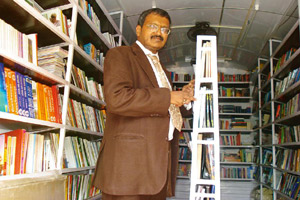
An electrical engineer by training, 45-year-old Kurulkar ran a networking and hardware solutions company for 15 years, before he put Rs3 crore of his own into Granthayan, a chain of mobile bookstores that travels the length and breadth of Maharashtra selling mostly Marathi books. Kurulkar says he plans to later replicate his business model in other states, focusing on books in their regional languages. 

As one can easily imagine, the roadblocks and problems that such an initiative would face are significant:

Only 59% of India’s rural population can read, according to the 2001 census, and reading material itself is limited outside the cities. Local languages have also had to face the growing popularity of English. “The situation is pathetic. People are migrating from vernacular language to English medium, and not at all passionate about reading Marathi,” says Kurulkar, who writes novels and short stories as well.
“Rural areas don’t see anything other than newspapers and textbooks. So good, affordable reading material, which is simple, is the need for the day,” says Rukmini Banerji, a programme director at non-government organization Pratham, which prepares an annual report on the status of education measuring student literacy. “Nothing is easily available like you can go to the paan (betel) shop and get gutka.” Pratham’s publishing arm, Pratham Books, which prints cheap children’s books, also has plans to enter the rural retail market next month, according to managing trustee Ashok Kamath. 

Kurulkar, however, is confident that this initiative of his will make an impact on the current scenario. His progress so far has been very impressive:

To date, Kurulkar says, his trucks have visited 28 out of the 35 districts in Maharashtra, and covered 80% of the state. The trucks follow pre-set routes—up and down the Mumbai-Goa highway for instance—and stay in a neighbourhood from a few days up to a week, depending on the amount of local business. Each truck has a staff of three, with a driver, an accountant and a helper on board.
According to Kurulkar, Granthayan has sold around 100,000 titles in the first three months of operation, and stocks both Marathi and English titles, though, he says, 75% of the company’s stock and sales are in Marathi. 

To know more about what are the bestsellers in the rural areas and what are the other problems faced by Granthayan, please do read the entire article here.

Image courtesy: Mint

Citizens to Fight Terror

The past year was ridden with terror attacks. And most of us shook our heads, deplored the state of national security, blamed the government for its lapse, and moved on. However, a citizen’s group in Delhi has decided not to blame others and move on. Instead, it has formed Jagruk Nagrik Suraksha Sangathan, a group of like-minded people with an aim to become self-reliant and responsible for their own safety.

Nidhi Bhardwaj tells us more in Mint about the objective behind this group:

JNSS President Denson Joseph says a citizen has to “take up the responsibility of becoming alert, forming a network, and falling in line, to secure himself and the people around him. If we do that, we would not have the security forces to blame.”

So how do they plan to go about achieving their goal? Their first step was to identify the most likely terror targets, busy and crowded market places. Then, two separate teams were formed – the Citizen’s Intelligence Network to keep a watch and report any suspicious activities in the area, and Citizen’s Active Response Team to take quick action in case of any emergency.

All the shopkeepers have been asked to volunteer just one worker to join the Citizens’ Active Response team. They would be expected to take note of any suspicious activities and people moving around the market.

The plan is already being executed at Sarojini Nagar and Mehrauli market, some of the most popular destinations for shopping and terror strikes in Delhi. The citizen initiative has received widespread appreciation and response from the market associations. Simple in idea and implementation, this plan urges the citizen to be alert and responsible for their own lives – a credo that could prove very effective in this age of mindless terror.

Read the complete article on this voluntary group here.
Image Courtesy: Urban Planning Blog

Eliminating Pesky Pesticide Residues

Pesticides may have helped in controlling crop damage and increasing yield, but their usage has become so widespread in India as to pose significant health risks to its population. After extensive application, pesticides like DDT and Aldrin have been banned to check further damage to health and environment. However, most of these chemicals have a considerably long lifetime, and are present in the environment for hundreds of years.

A team of researchers in IIT-Madras has developed a technology called nanoparticles that can effectively treat and eliminate one of the most obstinate chemicals in pesticides called organochlorine, present in the unpopular pesticides like DDT, endoulfan, dioxin and aldrin. Seema Singh reports about this successful experiment in Mint:

“Even though some of these pesticides have been banned, they are very much present in the environment. For instance, endosulfan has an environmental lifetime of 100 years,” says T. Pradeep, professor of chemistry at IIT Madras. His nanoparticles, mostly from gold, silver, copper and several oxides, are effective on endosulfan even at very low concentration. “Efficient chemistry at low concentration is important so that even if one molecule of the pesticide passes by, it gets removed by the nanoparticle,” adds Pradeep.

The next challenge for the research team is to formulate ways to make the technology percolate to the people who need it most, in rural areas. The costs need to be brought down to a large extent to make it accessible to the country’s poor.

Eureka is interested in taking this technology to rural population but the high cost of manufacturing could hinder the outreach for some time. “We intend to take this up as a no-loss, no-profit venture but that will have to wait until production goes up (and cost comes down),” says Abhay Kumar, general manager of water technologies division at Eureka in Bangalore. A community water purifier prototype, using nanotechnology filter, is under construction. It is scheduled to be installed in Kasargod district, one of the endosulfan-affected areas in Kerala, by March.

“This effort has to multiply, through all possible channels – industry, non-governmental organization and most importantly, government machinery,” says Pradeep, whose interaction with the Central water resources ministry turned out to be a one-way affair. Under the US Clean Water Act of 1972, the extent of contaminants in a glass of water is decreasing, but the number of contaminants entering potable water is increasing, says Pradeep.

It is sad to know that India ranks among the lowest in drinking water quality standards set by the UN (120 out of the 122 nations judged). However, these rankings should be taken as an eye-opener that imminent action is necessary. And we are glad to hear this piece of good news from one of the premier educational institutes of the country. We wish them luck in successfully taking their findings to the masses so that many can benefit from the advances in technology.

Read the complate article here.
Image Courtesy: RSC.org

Writing to save Cultures

India boasts of a huge variety of languages and dialects. Many of these languages do not have scripts of their own. In fact many of them are on the brink of fading away into oblivion owing to the trend of people migrating to modern cities and hence newer cultures. However, a small academy in Gujarat is standing tall to save these languages from dying.

Anand Giridharadas writes in this article at The Mint on how the Adivasi Academy, based in Tejgadh, Gujarat, is working towards chronicling elements of rural culture.

It is not only obscure languages that these students are trying to chronicle and preserve, but also cuisines, sartorial habits and other significant elements of rural culture. Like drivers heading downtown at rush hour, the students see everyone else going the other way. A swelling class of Indian aspirants from small towns and villages such as Tejgadh sees urban life and the English language as pathways to affluence, security and respect. 

The academy was founded by Ganesh Devy, who is a former professor of English literature.

He created the school, known as the Adivasi Academy, with a burning question on his mind: Why do we wait for cultures to die to memorialize them? 

The article further reports:

In recent years some people in Tejgadh have become professional artists, one example of a deeper transformation. Modernity has been creeping into the villages, and young people have been pouring out. But they are unprepared. They grew up speaking a language no one recognizes beyond their village, and they are inexpert in Gujarati, Hindi and English, the languages of urban employment. In the cities, they find it difficult to escape the most menial jobs.
Devy wanted to combat this gravitational force. Could Adivasis be persuaded to study their culture rather than shed it, and to stay in the villages rather than flee? 

To know more on how young people like Kantilal Mahala, 21, and Vikesh Rathwa, 27, are working hard to preserve their language and culture, read this wonderful article at The Mint.

Image courtesy: www.livemint.com

Training Villagers for Employment in Services Sector

eJeevika HR Pvt. Ltd. has initiated the training of villagers that enables them to secure jobs in services sectors like retail, business process outsourcing and security services.

Objective: To bridge the urban-rural divide in India. First, they identify entrepreneurs through village council heads, non-profits and self-help groups. Once identified, they offer them a franchise.

Vidhya Sivaramakrishnan explains in this article in the Mint:

The entrepreneur invests some Rs50,000 on a couple of personal computers, a broadband Internet connection and power back-up.
The franchisees then identify potential candidates who are then trained by eJeevika according to the requirements of its clients.
For now, eJeevika has developed training modules for security services, retail and business process outsourcing and would develop modules for other sectors depending on client requirements.

And how do villagers go about availing this training?

Villagers who wish to be trained register with eJeevika’s website after which the company conducts an online interview in the presence of its client. Once the client gives a go-ahead sign, the candidate pays a fee and undergoes online training.

We believe this is a good initiative to address the labour shortage problem and to enable villagers with limited information-access to take on a direct role in the emerging industries of India.
One of the persons interviewed in the article echoes this sentiment of ours:

“India requires innovations like these,” said Ravi Narayan, managing director at Mentor Partners, that works closely with start-ups. “IT (information technology) as a business model has become passé. How one uses IT to scale up is what many companies have increasingly started to look at.”

Of course there are certain constraints that the company is aiming to resolve soon, but overall they have shown some degree of success already, as the article says:

The firm has successfully piloted its model in Cuddalore and Tiruvallur districts of Tamil Nadu, she said. EJeevika trained and placed some 100 candidates with the help of a network of 20 franchisees in a few retailers and security services firms

Read the complete article here.

Credit: Link provided by Arjun Rao. Thanks!
Image from Mint

A new application of SMS – Providing prenatal care and advice to women in villages

Gurgaon-based mobile gaming company ZMQ Software Systems has come up with a new offering that will enable women in villages to register their date of pregnancy, and avail of weekly tips on topics like what to eat, what vaccines to get and when to get the next check up. Founders Hilmi and Subhi Quraishi, inspired by many of their formative years spent in socialistic environment of Soviet Union, have been redirecting 12% of ZMQ’s profits into social development programmes, and this is a project they are certain will succeed as it is mobile-based and independent of economic criteria.


Aruna Viswanatha reports in Mint:


ZMQ’s new programme also complements other initiatives around the country to pay women to have their children delivered by professionals, rather than by the untrained midwives more popular in rural areas. “There could be a programmed SMS before the day of the next check-up,” says Chauhan, “and reminders for the first tetanus, the first ultrasound, this would be a real great benefit if it is done.”


Also find what other companies like Enable-M and the venture capital firm Acumen Fund are doing in this space. Biju Mohandas, India business manager for Acumen Fund says he is considering many business plans that intend to use SMS technology in rural health care. Read the complete article here.

Training Program for Indian SMEs

As per some unconfirmed reports, there are more than 25 lakh Small and Medium scale Enterprises in India. These enterprises offer a diverse range of services and products. However, one of the main issues facing these industries is the lack of exposure to international level best practices. Practices that could help them achieve better efficiency and scale. For such enterprises, now there is some good news. The Indian Institute of Management (IIM), Calcutta and the Indian Institute of Technology (IIT), Madras along with Shobishiba, a Japanese management consultant have come together to devise a training program for these Indian SMEs. According to this article in The Mint, the program will help the enterprises in identifying the gaps in their practices in comparison to those in the developed nations and will train them in how they could bridge these gaps and attain better standards.
Excerpt:

The programme would start with 15 firms initially and the volume of participation would grow later depending on the success of the maiden run.

“Our aim is to help Indian SMEs understand why they trail the best SMEs in the world, and what they could do to achieve the same standards,” said Ramesh Datla, chairman, CII MSME (micro, small and medium enterprises) Council.

We at The Better India believe that such a training program was long due. It will help us not only to scale greater heights, but will also ensure that the entrepreneurial spirit of these workers will now get a better and organized channel to harness their own talent.

Read the complete article here.

Schools are cool with Radio and Blogging

Now, this comes as a sort of celebration for us at The Better India. Pallavi Singh writes in this article at the Mint about a policy being formulated to encourage children at school to use community radio and er, well, blog!

This is cool, we think, since it is introducing helpful technology to children in their early years. Excerpts from the article:

Blogging, the recommendations say, should be encouraged to support creative writing. “Blogs are powerful tools to support creative writing that can be published and shared not only with the teacher but also with peers and the world, alike. Spreadsheets, databases, concept maps, and hypermedia authoring tools (Web development tools) to encourage critical thinking could also be encouraged,’’ the draft compendium says.

It also suggests use of digital devices like robotics kits, digital microscopes, graphing calculators and global positioning system devices for science, math and social sciences curricula. To improve rural access, the draft recommendations also press for creation of localized content to be accessed on the web to help children “proactively explore and capture local realities’’.

However, some people have raised some misgivings about this policy too. Nothing is just one-sided now, is it.

Read the complete article to know more about the pros and cons of this policy.

Credit: Link provided by Vikas.

Teach for India

It is education once again appearing on The Better India.

Samanth Subramanian writes in this article at The Mint about the “Teach for India” campaign:

Around this time next year, 100 fresh college graduates will find themselves back in the classroom—but this time they’ll be standing in the front, teaching.

They may not want to be teachers, they may have no teaching degrees, and they may never teach again. But, for two years they’ll work in primary schools as part of the inaugural batch of the Teach For India, or TFI, campaign.

The initiative is funded wholly by the Michael and Susan Dell Foundation.

Read the complete article here.
Also See: All posts related to Education

Tribal Art and Computer Animation

Finally, we are beginning to see some convergence of two ends of the spectrum. The technology behind computer animation is now being introduced to help bring out the native artistic skills of tribals from various regions of the country.

Shruti Chakraborty writes in this article in the Mint, titled “Technology helping bring tribal art to life”.

Excerpt:

Gond tribal artist Gariba Tekam had never even seen a computer till two weeks back. Now, he’s working with technology to bring his images to life.

As he paints a blue fox on a piece of paper, part of the storyboard for an animation film on a squirrel’s dream, Tekam says he is excited to help one of the many folk stories from his Patangarh village in Madhya Pradesh reach a wider audience.

The artist’s quantum leap into computer technology comes after two days of not-so-intensive training, part of the two-week animation workshop conducted by the Adivasi Arts Trust, or AAT, at the Indira Gandhi National Centre for the Arts, or IGNCA.

As of now, the program has on board tribals from three regions of India – the Gonds from Madhya Pradesh, Santhals from Jharkhand and West Bengal, and Meiteis and Thadou Kukis from Manipur.

To know more about how the project is being implemented and the genesis of this wonderful idea, please read the complete article here.

Calendar

September 2010
M T W T F S S
« Aug    
 12345
6789101112
13141516171819
20212223242526
27282930  

Recent Comments

PROMOTION

"Neumonia and Other Sketch Stories" - A collection of sketch stories. Download the e-book for free. Click on the book cover below.
"The observations are acute: the sound of high heels on asphalt, the bit about how all BPO employees lose their hair very fast are spot-on. This book is a better, shorter alternative to any Sunday movie on TV. It's a little jewel" - Hindustan Times