






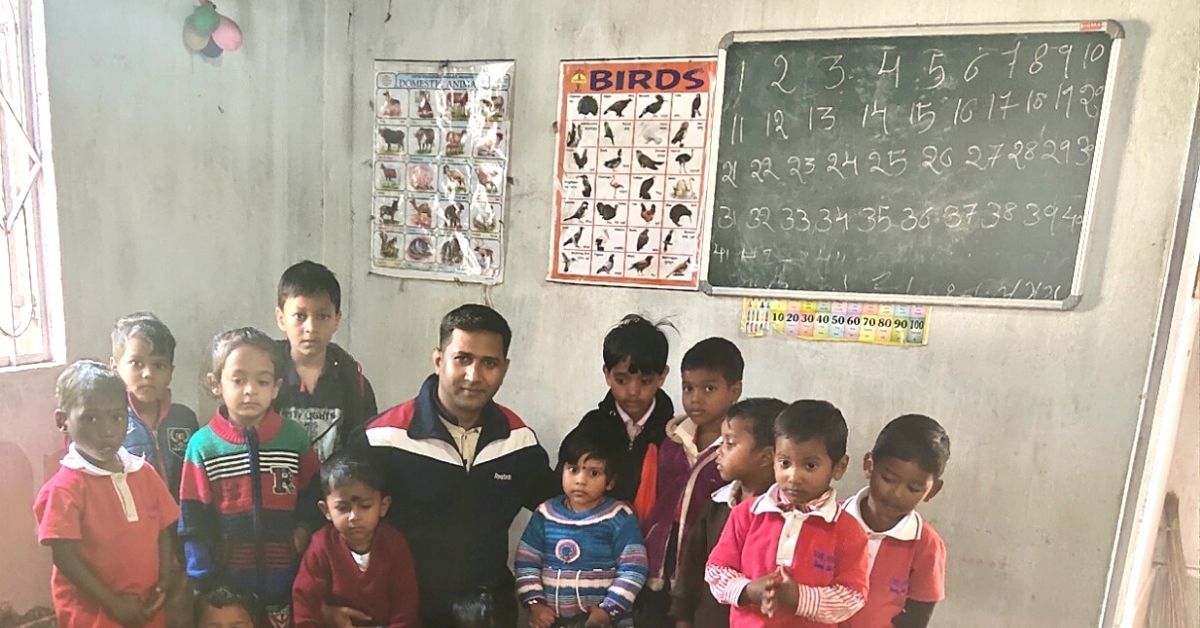
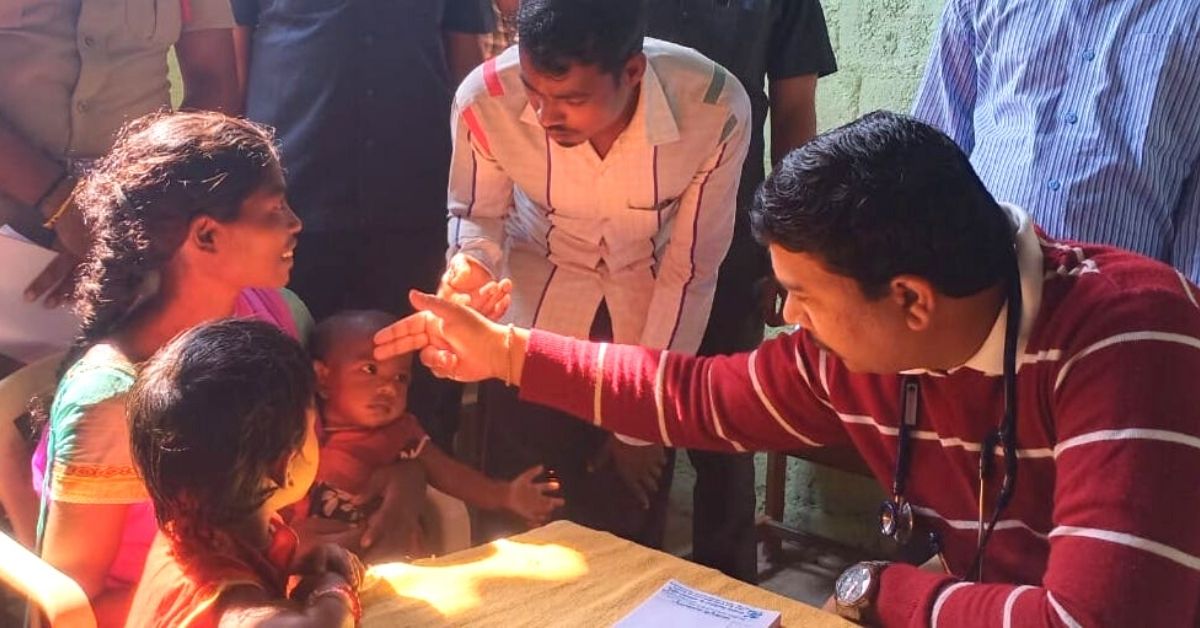

Door Step School: Education now goes to every doorstep

India is a developing country with a developing population, developing economy, developing education. But is education really developing amongst the people who are born poor and underprivileged. Door Step School has taken the big leap to change the present and to make 100 percent literacy a reality. This is a group of people whose main motivation in life is ‘service to society’ and they believe the best way to do so is to usher in a wave of knowledge that engulfs the future of our nation – the children. Meet Mrs. Rajani Paranjpe, the founder member, who says “We go where ever the children are and start the class right there”.

School on Wheels

School on Wheels

This inspiring lady, whose mission in life is spreading primary education, has closed many prisons as the saying by Victor Hugo goes “He who opens a school door, closes a prison”. When approached by The Better India for a brief glimpse into their world and how they work, she was kind enough to answer all our questions. Below is a detailed interview with Mrs. Rajani about her fantastic initiative, Door Step School:

What is the main objective that Door Step School is aiming at?

Hundred percent literacy through total school enrollment and quality education for all.
We bridge in the gaps in government’s efforts in achieving these goals. Our public education system faces three major problems in this regard, namely, non-enrollment, wastage (dropping out of school at early stage) and stagnation (not achieving the expected level of learning at respective stages in school). All our programs are designed to address these problems.

Education moves on to every door step – What was the initial thought process behind this philosophy?

I am a Social Worker by profession. I took this path because I always liked to work for and with people. So after nearly 15 years of my graduation (and infact 15 years of married life!) I took up a course in social work and after a few years of working in the field I joined the College of Social Work Nirmala Niketan, Mumbai, University of Bombay, as a member of faculty. I used to teach Research Methodology and Indian Social problems.

I selected Primary education as the mission of my life because I felt:

  • Education or rather illiteracy was the problem we needed to address on a war footing
  • Working with just one person in a family is usually sufficient because that person with a little education sees to it that his/her children get education.
  • We focused on 3-18 age groups, because my experience says it is far easier to teach a child than to teach an adult.
  • Messages such as health and family planning etc. can be given to a much larger population at much lesser cost if the population is literate.
  • Education is one national problem which can be solved permanently once all the children are in school and are literate.

I made a plan to start four programs through Door step School. They are literacy classes (literacy is defined as being able to read a newspaper), study classes, pre-primary education and community libraries.

After having a clear idea of what I wanted to do, I shared it with like minded people one of whom was Ms. Bina SethLashkari, a student of mine for two years. She and a few others from the college joined hands with me and we founded the organization in 1988-89 in Mumbai.

We named our organization ‘Door Step School” because we go where ever the children are and start the classes right there. E.g. we held classes on pavements or on road construction sites, building construction sites outside big markets, railway stations etc. We have added a few more programs along the way but the core programs have remained the same.

What challenges did you face in the initial day? How did your team deal with them?

We did not face many major challenges as such. I think the following factors helped us in our smooth functioning:

  • All of us who started the program were professional social workers and were in the field of social Work for some time before we started an organization.
  • The field we have selected is relatively simple, the work is primarily developmental,
  • The time was ripe for such activities and
  • We had a very focused approach with clear plan in front of us.

However, after we started working with the children of construction workers, we faced the challenge of tracking them when they moved from one site to another. Our search for an effective solution to this problem is still on.

Could you provide a brief insight into the projects that you run?

Computer as a teaching aid

Computer as a teaching aid

As I have mentioned earlier, all our programs are designed to address three major problems of our public education system. The target group is 3-14 (although we cater to children upto 18).
Pre-primary education serves two purposes – it prepares the child and the parents for schooling. On a more practical note it gives us the idea about which children are ready for school admission at the beginning of the next academic year. This ensures near-complete and timely enrollment.

For admitting children to school a birth or age certificate is required which many of the parents we deal with do not possess. We help them to get the age certificates and enroll children in school.

We provide school transport so that children attend school regularly which helps preventing school dropout and stagnation.

Study support classes to children attending school helps improve the quality of education which in turn reduces the chances of dropping out of school prematurely.

NFE (Non–Formal Education) classes helping reduce illiteracy.

School on Wheels, a bus which is designed as a class room helps us to take classes for children who are on streets and there is no place to gather them and teach them. It helps to cover those who would otherwise remain untouched.

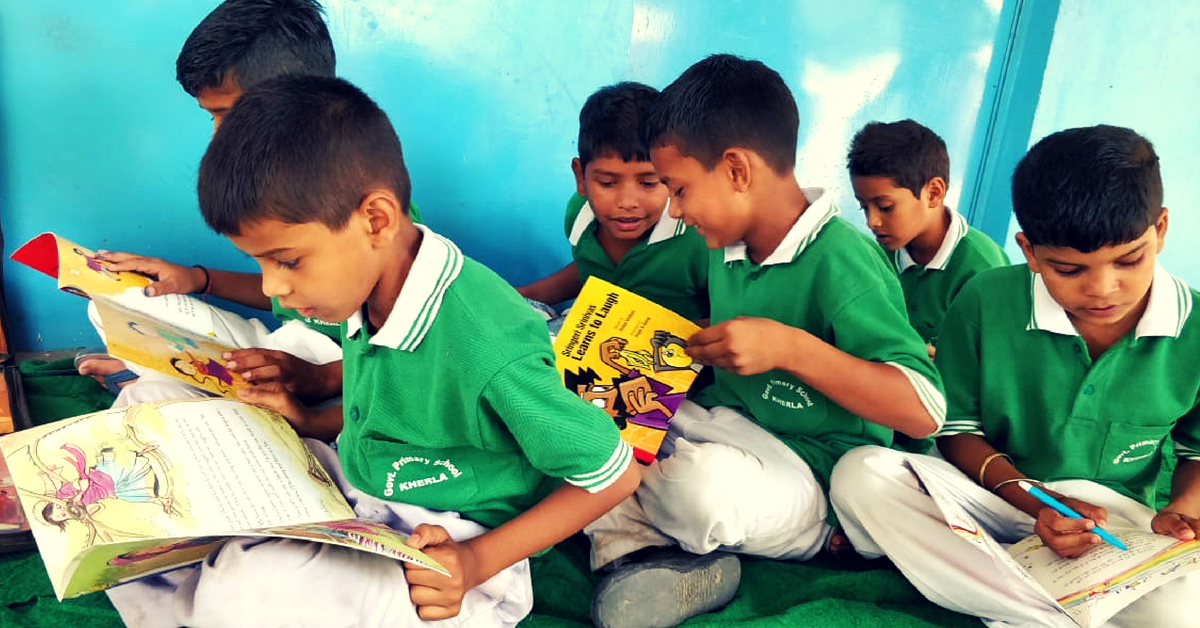
School and Community Libraries as well as Reading Classes based in schools help in improving reading ability which is basic to any educational achievement

As an ending note, would you be able to tell us the difference that Door Step School has brought about on our society?

It is difficult to answer this question because the work we are doing is very small as compared to the need for such programs. Therefore I would rather not claim anything on the scale of society or nation.

However in the lives of children whom we have touched we have definitely made some impact or the other although this impact is not perceptible or measurable always. Some of our children have completed education and doing well in life. Some have left education midway and continued with their lives. It is their children who will benefit from the exposure we have given to their parents.
We experience this and we have many examples to show that a child who was with us even for a short time has nurtured a dream of sending his/her children to school and acts upon it when the time comes. We see this change in the attitude of ‘parents’ as our major gain. It shows that the root of education has struck in the family and now we do not have to worry. It will spread, we hope.

To know more about Door Step School, visit their website here: www.DoorStepSchool.org

Tip provided by a TBI reader, Zankhana Patel.

This article has been written by Malavika Tewari. Malavika is a NIFT graduate and has been working in the apparel sector for past 2 years. She has great fervor for reading and has observed the delight in writing for past few years.

Masoom – Illuminating the Night Schools of Mumbai


Twenty one year old Amol Pashilkar attempted his SSC examination in the year 2004-05. Unfortunately, he could not clear his examinations; he passed only in English. Since his confidence levels suffered a blow, he found it very difficult to reappear. After a four year long gap, in 2009, he took admission in Milind Night High School. With his renewed focus, could he clear the examinations?

Amol got 74% in his SSC. How did this drastic improvement come about? Amol could leap forward in academics because of the extra classes conducted by a Maharashtra based social organization that goes by the name Masoom. Masoom works with night schools in Mumbai, with the aim of improving academic performance of night school students.

Masoom is the first organization in Maharashtra to run a comprehensive intervention program for night schools. Masoom offers a unique approach to planning and implementing a comprehensive program for night schools based on their different needs. Masoom’s strategy for sustainable change is to work in the spirit of partnership with all major stakeholders in the education system. Because of Masoom, many like Amol could complete their education. Their interest in studies increases tremendously.

“I came across students who were largely self-motivated. They worked during the day and would attend classes in the evening. Nobody was forcing them to school. They came because they wanted to learn.” – Nikita Ketkar, Founder of Masoom

Tracing the beginnings

Nikita Ketkar, the founder of Masoom, stumbled upon the idea of helping night schools back in 2001. She was working in the civil services and was appointed on a project to identify child domestic workers, in the night school of Mumbai. Nikita adds, “I came across students who were largely self-motivated. They worked during the day and would attend classes in the evening. Nobody was forcing them to school. They came because they wanted to learn. It was sad to see that justice wasn’t being delivered to their aspirations.”

Masoom - Basic Science Concepts taught in a night school

Masoom - Basic Science Concepts taught in a night school

In 2006, Nikita further undertook research related to problems faced by night school students, under the Pukar Scholarship. Based on the findings, she decided to do something about these issues. She resigned from office and founded Masoom in 2008, her entire research team by her side. To facilitate learning for night school students, Masoom has developed a three pronged approach:

1. Providing Infrastructure such as computers, Science laboratory apparatus, mathematic kits, library books, notebooks, educational charts, workbooks and worksheets, teacher training material, Braille textbooks and audio-visual material

2. Capacity Building by organizing training sessions and workshops for teachers, parents and students, vocational guidance for students, counseling, extra curricular classes such as Life skills, yoga, meditation

3. Advocacy: Masoom works closely with all stakeholders and intend to act as an advocate for all issues concerning night schools

Since night schools are run from 6:30 to 9:30 in the evening, most of these kids come after long hours of work. By providing meals, Masoom ensures that they can study more efficiently. Nikita adds, “We want to build not just academic strength but also employability. Many students who earlier had to study with an empty stomach could not focus. Now we provide meals. The kids call it ‘nashta’ as sometimes it is the only meal they have in the day.”

Sports as part of the night schooling

Sports as part of the night schooling

Members of Masoom

In its own unique way, Masoom has touched the lives of many students, growing from just two schools to now ten. There are courses called the ‘bridge courses’ that help drop outs overcome gaps and at the same time, there is facility of psycho counseling for students with learning disabilities. They also help link students to government certified computer courses, for which they have initiated scholarships for part funding. With such personal care and concern for holistic development, there are bound to be many many success stories like Amol’s.

Visit Masoom’s website here: http://masoomforu.org/

People for Change: Spreading Education

Walking on the heat-radiating Delhi road, I noticed a bunch of Government school children clad in their blue uniforms, aiming for the fruits on a ‘Jamun’ tree with stones. Their evening snack was happily hanging from the branches hidden by innumerable leaves growing in all directions. I wondered how these children managed their studies with hardly anybody at home to guide them. It is not that these children are any less intelligent than the children who are economically blessed, but it is just that they don’t the right kind of supervision.

The difference between the organization “People for Change” and me is that I simply thought about it while they worked on it. “People for Change” is an organization that conducts tuition classes for underprivileged children in order to guide them in the right direction and prepare them well for the future. The organization was founded two years back with mere five students in a play school’s building which was lent to them during evening hours. It is now situated in Dayal Bagh, Faridabad where they have an apartment to themselves, the rent of which is paid by one of the many donors. It has children from class third to tenth totalling up to a hundred students at present. They have recruited 2-3 teachers who help the students with their homework, prepare them for lessons in advance and also teach them various crafts like paper bag making, art, origami etc. An addition to the teachers there are a few college students who teach on a voluntary basis. The founders of this organization, Ms. Nellie Dhillon and Ms. Nisha Celly, also come to teach on a regular basis. They believe that it is only when the children get appropriate exposure that they will get encouragement to do better. In order to encourage the children to strive for excellence, the organization rewards the students who perform outstandingly well in their annual examination.

Education has evolved to become a blend of academic excellence and personality development. Working on these lines, “People for Change” conducts an annual function where all the children participate. In addition, they organize stitching, embroidery and other hobby classes during summer in the month of May. The aim of these hobby classes is to inculcate life skills in the children and to make maximum utilization of their free time.

“People for Change” would appreciate more citizens to come forward and help them in spreading education to the needy. As “People for Change” is an expanding not-for-profit organization, it needs more people to help their cause in any little way they can. Anybody willing is welcome to help in their mission to attain hundred per cent literacy. Details can be obtained at the following number: 9899401882

This article has been written by Kanika Gautam. She is currently pursuing Bachelor of Commerce at Delhi University. She has been a part of the Shadow Editorial Board with Faridabad Times, Times of India. She is an alumnus of Mother’s International School, New Delhi and has been on the Editorial Board of her school magazine. She has also made contributions to her college magazine, has a passion for social work and a zeal for writing.

Conserve India: Using Fashion Against Poverty


Urban India is glaring at a huge waste management problem with no clear policy examining waste as a part of the production-consumption-recovery cycle.  In India, over a million people find employment in rag picking and recycling of waste; and this is an unorganized sector.

Most of the rag-pickers are poor, illiterate and belong to rural immigrant families. Many commence their profession at the young age of five to eight years. Most of them have never attended any school. While collecting rags they are subjected to chemical poisons and infections. Due to malnutrition, they suffer from stunted growth and anemia. These rag pickers have been weaned out of our social fabric and as begging is being abolished more and more beggars are becoming a part of this scavenging community.

Conserve  India, an organisation in Delhi founded by Anita and Shalabh Ahuja  was born of a desire to reduce India’s mountain of waste. Their team, after a lot of research, struck upon the idea of Upcycling by washing, drying and pressing plastic bags into sheets.

Handmade Recycled Plastic (HRP) is  made from  polythene bags picked from Delhi’s streets, rubber from old truck tyres’ inner tubes, old denims and saris. The processes used to make ‘Conserve’ bags and accessories have been specifically developed to be as energy efficient as possible and to keep out polluting dyes and chemicals.  This not only helps the environment, it also cuts costs, giving the organisation more money to invest in other social projects.

Santosh Kumar started collecting plastic bags for Conserve India as he could earn three times as much by selling plastic bags to be made into HRP instead of selling the garbage elsewhere.

Ragpickers enjoy working for Conserve as it directly implies that they, perhaps for the first time in their lives, will have enough to feed their families and rent homes that they can be proud of. On an average, a conserve ragpicker earns around $70 a month compared to a ragpicker who earns somewhere around $25.

The ragpicking community is unorganised; it is hard for them to protect their rights. By giving them ‘Conserve Employee Cards’, Conserve India helps them have a voice in the society. Conserve India has also started a campaign called Recognition for Ragpickers. As part of this, the organisation is trying to persuade the Delhi government to create an official register so as to recognize Delhi’s 150,000 ragpickers and give them their right to a fair wage.

Conserve also offers training to its workers so they can do better jobs in their organisation. Conserve supports schools in slums where many of its employees live. With an initial funding from Asian Development Bank, Conserve is now starting two new projects for tracking the general welfare of its workers and providing health clinics for those who have no access to healthcare.

In collaboration with top designers, Conserve India makes high-end fashion items like handbags, wallets, shoes and belts from the handmade recycled plastic.

Conserve India has collaborated with Fair Trade for marketing its products, which are available in stores across US, Japan, Europe . Their products can also be bought online through the Conserveshop.

By buying Conserve’s products one not only gets to be a trend setter in fashion, but also gets to help some of India’s poorest people and its environment.

For more information visit their website http://conserveindia.org. Infact if you want do something about the waste clogging the streets of your city, you can set up your own Conserve and be the change that you want to see in the society. Mail Conserve India at info@conserveindia.org or call on +91 11 43095301.

New! Jobs Listings featuring internships, volunteering opportunities & more. Click here.

Where the earth meets the sky – Timbaktu Collective

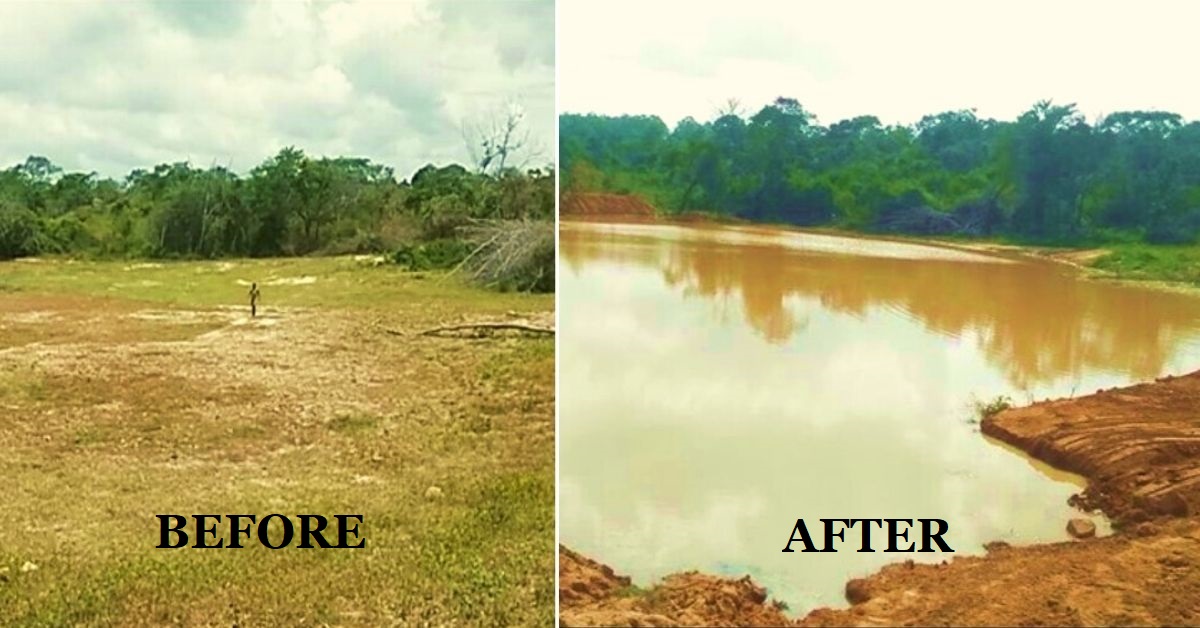
This is the story of a land that was at one time lying ravaged, drought stricken and forsaken. It was a committed revolution led by a couple, Bablu Ganguly and Mary Vattamattam, which has now transformed this land into an agro forest habitat. The unproductive soil was rejuvenated, rain water was harvested, trees were planted, crops were cultivated and the entire land blossomed.

Timbaktu in 1990

Twenty years ago, Bablu and Mary set their foot on this barren land in the district of Anantapur in Andhra Pradesh. People had given up on this land, of which Bablu and Mary decided to buy 32 acres; probably the last thing one would expect from a young couple.

The spark that triggered this initiative was a book – ‘The One-Straw Revolution’, by a Japanese author Masanobu Fukuoka. The book carried a very special message on how humanity can live an enriching life hand in hand with the nature. Bablu and Mary carried this spirit and conceived their vision for this land that they called ‘Timbaktu’, meaning ‘Where the earth meets the sky’. Their aspiration was humble and they wanted to keep everything simple – get closer to the land and help it regenerate itself.

They knew there was potential in the land of Timbaktu which was once part of the rich and powerful Vijayanagara Kingdom. Its forests were considered to be the finest, its fruits were savored across the country and various armies fought to keep control of this once fertile land. But everything was destroyed by ruthless deforestation and use of environmentally damaging pesticides and fertilizers.

Over the years, villages in this region have been tormented by chronic drought, unproductive land, unemployment and poor infrastructural facilities. Bablu and Mary decided to build the Timbaktu land by engaging with the villages around and formed an NGO called The Timbaktu Collective. “Our vision is to stop the degradation of the land in Anantapur district and to find ways to reverse it. We want to green the hills and the land. We want to develop alternative lifestyles. Lifestyles that are sustainable and provide more liberty and happiness, than those based on exploitation. The farmers see their land degrade and the wells drying up, but they don’t know what to do, so they just continue their patterns of self-destruction. We want to find a path that leads out of this vicious circle, not without but together with them” – they say.

Timbaktu today

In 1991, the couple decided to put their first crop in the land of Timbaktu and as everyone around them said, the crop failed. That became even more instigating – Bablu went ahead and bought 7000 saplings. He and Mary brought farmers from the villages to build creative water harvesting structures ensuring that every drop of water was judiciously used. Seed dibbling and such traditional farming methods were practiced – and the colour of the land started changing. Timbaktu was transformed from a barren earth to a lush green forest. It’s heartening to see that birds, snakes and butterflies have come back to Timbaktu and a lost glory is reinstated. This is a true success story of eco-restoration and the experiment is being replicated with community support in a 10,000 acre waste land named as Kalpavalli.

The Timbaktu Collective grew to become a 105 member strong team who serve over 140 villages in Chennekothapalli, Roddam and Ramagiri mandals of Anantapur district. The organization runs two schools, one of which is a residential school for children from disadvantaged families. There is also a thrift credit system for the women which has now grown into a well established alternative banking system. Farmers in the villages are given training in organic farming methods and the Collective supports a Cooperative Society that assists the farmers in marketing their organic produce. With youth development, child rights activities, helping the disabled, cultural activities and many such programmes, the Timbaktu Collective has changed the face of humanity here.

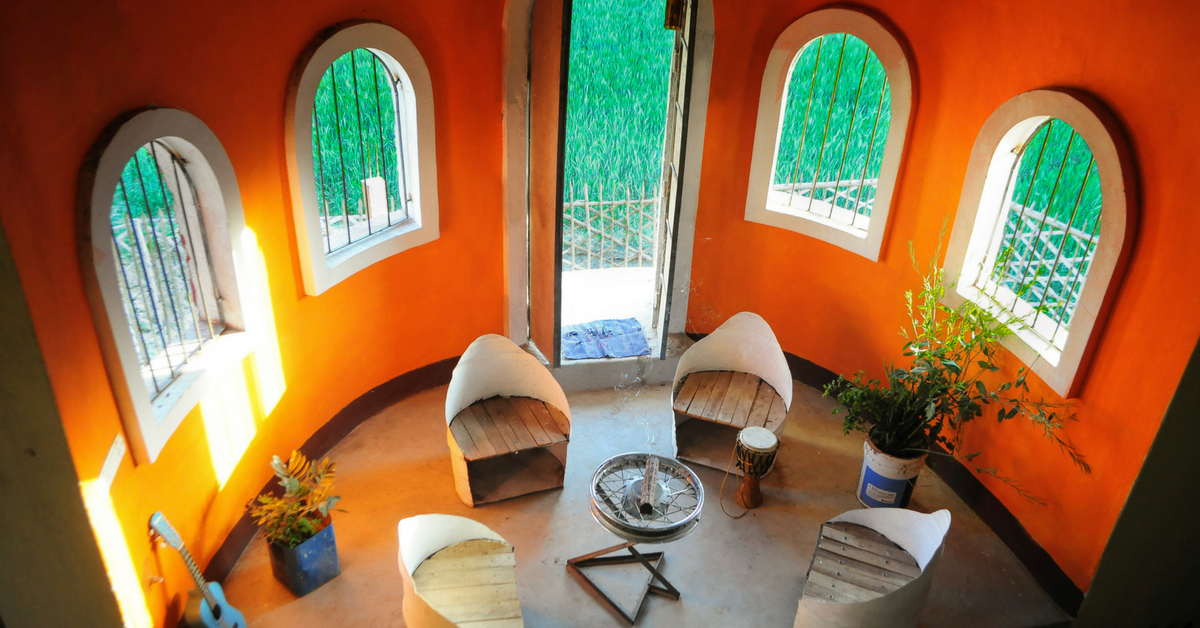
Bablu and Mary stay in Timbaktu, in a house that is built with mud, built by them and built using things available in the land of Timbaktu. Their children studied in the school run by the NGO for the villagers. Their organization has made a difference to the lives of over 12,500 marginalized families. How much more purposeful can their lives get? How much bigger role models do we need to start doing our bit for the world around us?

Visit Timbaktu to know the true spirit of this land. Find information about them on their website www.timbaktu.org. Also, watch this video where Bablu and Mary take you through the 20 years of Timbaktu. You can also write to them at timbaktu.info@gmail.com

Pravah: Inspiring Youth Citizenship

Pravah, an organisation based in Delhi works with young people to impact issues of social justice through youth citizenship action . Pravah believes that sustainable change emanates from individuals. “Change them or their orientation and the system will change.”

Pravah works with both adolescents as well as young adults, through two broad interventions, the School Programs and Youth Action.
In Youth Action they basically have 5 programs:
1. SMILE – which stands for Students Mobilisation Initiative for Learning Through Exposure. The aim of this program is to involve the youth in activities which helps them belong to their background and take more responsibility in whatever they do.

2. Youth For Development – is a partnership between Pravah and Voluntary Service Overseas ( VSO) . In YfD , the individual gets to work in a rural area for six months . Also, there is a 2 week training schedule before the commencement and constant mentoring.

3. Global Xchange – is a 6 month long international volunteering exchange programme in collaboration with VSO and British Council.

4. Change Looms – is a leadership and Organisational development programme that supports , encourages young independent projects or organisations working for social change .

5. Campus Catalysts- is for campus based initiatives for the youth involved in social action on or outside their campuses. The aim of the program is to mobilise social action on campuses.

School Programs are :

1. From Me To We – is focussed on inspiring adolescents to take up active leadership in areas of social change. In this , learning and life skills programs are conducted in cooperation with schools under FMTW. Theatre, games, simulation exercises, stories, case studies are a core component of the curriculum. FMTW currently reaches out to 3500 students in over 30 schools mainly in and around Delhi, Rajasthan, Gujarat and Karnataka.

2. Fun Camps – for kids between 13 and 17 , these are 6 day trips to villages, for teachers and various theme based fun trips.

3. Teacher’s Training – Pravah trains teachers for one year to design and conduct life skills program. Educator’s Collective is a network of school teachers, educators working for social transformation.

4. CLAP- Citizen Learning and Action Program is for adolescents between 13 and 17 who feel strongly about a cause. CLAP helps you to take that forward, and develops leadership skills in making social change. CLAP partners with Sanskriti School and Ford Foundation.

Also, they have started the Pravah Jaipur Initiative supported by Sir Ratan Tata Trust. The centre will create knowledge bank for various programmes by offering media fellowships for youth development, workshops, seminars and volunteering placements.

Films With Wings is a collaborative initiative of Pravah and Interactive Resource Centre, a non profit in Pakistan. Founded on the principle that films are a powerful medium in bridging various divides, FWW is an effort which provides a dynamic platform for young minds of both nations to engage, co- create , challenge and capture a variety of experiences and expressions through a serious of Intensive dialogues , workshops between youth of both nations followed by a Film festival.

Website : http://pravah.org

Narayan Seva Sansthan: Helping Polio Victims

Situated in the lake city of Udaipur, since its foundation on 23rd October, 1985, Narayan Seva Sansthan has been working for the “service of suffering humanity”. Since its inception, Narayan Seva has been rendering its services to physically, economically and socially needy people. The organization helps the physically challenged, especially the polio afflicted and those born with disabilities. The help is not only medical, but goes beyond it to ensure that the people are made self-dependent via employment.

Since 1985, over 95000 polio afflicted people have been able to stand on their legs after getting successfully operated under Sansthan’s move towards self-dependence of the handicapped. Besides free distribution of clothes, medicines, food grains etc. to the tribal in remote areas, it also provides free vocational training to the physically disabled and economically weaker sections of the society. It has provided facilities for the training of these people in wood craft, carpentry, black-smith trade, leather work etc. supplying the necessary tools and raw materials to begin with.

The organization has also been running an orphanage taking care of children who become orphan due to ‘Nata-Pratha’ – a social evil prevailing in this region of the country in which after the death of the husband, the wife goes away to stay with some other man leaving the children behind . Over 600 children have been taken care of and sent back to the main social stream.

As a part of its endeavour to make medical care available to poor patients at their door steps, the Sansthan maintains a mobile medical care unit. Equipped with all necessary modern facilities, the mobile medical unit is always kept ready to rush to any spot when urgent medical care is required. Apart from all of this, the Sansthan is also involved in promoting values of Indian culture as enshrined in some of the epics and scriptures. The Sansthan has been organizing expositions on Ramayana, Puranas etc. with the purpose of spreading the message of humanity.

Narayan Seva Sansthan has been creating success stories and looking after a section of the society that most often gets overlooked.
To know more about the organization visit: http://www.narayanseva.org/

This article has been contributed by Chandrika Maheshwari. Chandrika is a student in her 3rd year of engineering in BITS, Pilani and holds a vision to do something for the country and contribute in its development. Her interests include social entrepreneurship, traveling, reading and writing.

Zameen: Bringing an Agricultural Revolution


We have all read and heard about farmer suicides, pesticides in food and issues of child labour. Here is an organization that is working towards the eradication of all of these – Zameen.

Zameen is a unique farmer owned organic cotton trading company working to improve market access for marginalized farmers in India through certification, supply chain partnerships and organizational development.
Cotton farmers in India do not receive a fair price for their produce which leads them to usurious money lenders. Huge debt and inability to support their families leaves suicide as the only dignified option. In the Amravati district of Maharashtra, 5000 farmers commit suicide every year and that is an alarming statistic.

Zameen believes in the ‘trade, not aid’ approach to rural development. Farmers invest their own capital in Zameen and are completely engaged in the process. Zameen has a tie up with AOFG (Agriculture and Organic Farming Group), a non-profit organization, to facilitate the development of independent, legally registered farmer cluster associations that are self managed and are able to sell organic cotton as per strict international standards.

Infamously referred to as ‘dirty cotton’, the commodity accounts for 16% of global insecticide use which is far more than any other crop. Agro-chemicals contaminate local water supplies, degrade soil quality and harm wildlife. Farming communities also face an increased risk of various diseases like cancer. Zameen trains farmers in organic farming which has resulted in drastic improvement in soil fertility and farmers’ health.

As a Fairtrade certified organisation, Zameen farmers are no longer subjected to widespread speculation and fluctuation in market prices. Fairtrade guarantees a minimum price which covers sustainable farming and living conditions. Additionally, a social premium is earned by the farmer community and that premium is democratically invested in community development projects. So far, Zameen’s farmers have invested in wells, their children’s education and ofcourse into their own businesses.

Fairtrade prohibits child labour and encourages movement towards gender equality. Zameen farmers have access to international markets and being organized into an association gives them a stronger collection voice.

Know more about Zameen and their activities.
Website: http://www.zameen.org/
Facebook : http://www.facebook.com/pages/Hyderabad-India/Zameen-Organic/130739011014/

Ecosphere Spiti: Social Innovation at the Foothills of Himalayas

Spiti, a tranquil valley in Himachal Pradesh at an average altitude of 3600 meters is home to around 10,000 Buddhists. Spiti Ecosphere is a social enterprise formed by the collaborative effort of the local community and professionals from diverse backgrounds with the aim of creating sustainable livelihoods linked to nature and culture conservation.

Spiti Ecosphere is focussing on the economic empowerment, development and conservation of the region through their range of products and services. These include the following:

  • Eco Travel which takes us close and personal with the mighty Himalayas and the nature & culture of Spiti. It is an initiative to promote eco-tourism in the region. Eco Travel offers various options to the discerning traveler ranging from a Spiritual Sojourn of the monasteries to the Pugmarks where one gets to track the elusive snow leopard and the Himalayan wolf in the midst of this treasure trove of biological diversity.
  • Organics – Spiti’s unique ecosystem is richly endowed with various indigenous species. Ecosphere has streamlined the process for extracting and sourcing these rare Himalayan herbs including SeaBuckthorn popularly known as the “Wonder Berry”
  • Conservation – Mountain ecosystem and economics share a symbiotic relationship, and maintaining the balance with the environment is critical to the sustainability of livelihoods. Muse, Spiti SeaBuckthorn Society and Spiti Trans-Himalyan Action Group have been working in the region on the issues of climate change, promoting renewable energy, waste management and the Dhangkar initiative. Dhangkar, originally called Dhakkar meaning ‘citadel on a cliff’, was the erstwhile capital of Spiti . The Dhangkar Monastery is one of the five major monastic centres in Spiti and belongs to the Gelug–pa sect of Vajrayana Buddhism. It is a heritage conservation site in a state of despair listed in the ‘World’s Hundred Most Endangered Sites’ by the World Monuments Watch Program. Check out www.dhangkar.com to know more about Dhangkar


In the near future, Ecosphere plans to come up with some very innovative projects. One of them includes “Environment education in schools”, the belief being that awareness about the environment should start early by educating children in schools. They are also planning to come up with a short documentary showcasing the Spiti way of living and at the same time sensitising travelers and communities on how to ensure that it remains preserved.

To know more about Spiti Ecosphere and the wonderful work they are carrying out in this beautiful valley of the Himalayas, visit their website at http://www.spitiecosphere.com/

You can also connect with them on Facebook: http://www.facebook.com/group.php?gid=55566667952

For volunteering and other opportunities, mail them at info[at]spitiecosphere[dot]com

Agastya: Sparking Creativity in Rural India

Spread over a vast area of 170 acres of rocky wasteland in Kuppam, a deprived rural area in Andhra Pradesh, Agastya International foundation believes that complete learning is a combined form of shiksha (education), samskara (values) and sansara (world). It focuses on transforming the critical and much neglected area of primary and secondary education of the rural masses in India, including children and teachers.

Agastya runs one of the largest hands-on science education programs in the world!

Agastya does this by bringing hands-on science education to the rural masses through the use of outreach programs like “Science on Wheels” (Mobile Labs), Science Fairs, Teacher Development Program and Young Instructors Programs. Agastya seeks to fill the gaps in the Indian education system that threaten its socio-economic development. The conventional Indian education system instills little creativity in children and teacher education is generally divorced from classroom realities. Agastya’s projects overcome these problems with their unique features which involve idea generation and testing through the Creativity Lab, creativity generation for poor and disadvantaged through interactive and engaging learning methods, learning linked to environmental goals, emphasis on developing behavioral skills and a close link between teacher education and the classroom system.

Agastya: Science on Wheels

If you ever hear Ramji Raghavan (Founder, Agastya International Foundation) speak, you would certainly hear him talk about the learning pyramid as he strongly believes in the fact that we learn about 5% of what is taught to us in a lecture, 10% of what we read, 50% of what we see and hear, 70% of what we discuss with others, 80% of what we experience and 95% of what we teach. Ramji Raghavan, a former NRI banker came back to India with a vision of providing education to poor children and teachers – education that would be the opposite of conventional techniques and this led to the birth of Agastya, named after Mahirshi Agastya, famous for spreading sacred knowledge to south India, as a charitable trust in 1999.

Agastya has started off successfully on the path of building a creative India of ‘tinkerers, solution seekers and creators’ that are ‘ humane, anchored and connected’ by impacting over 3 million children and 120,000 teachers from vulnerable and disadvantaged communities. The model is scalable and replicable anywhere in the world.

You can take a look at Agastya’s visual documentation here.

Website: http://www.agastya.org/

This article has been contributed by Chandrika Maheshwari. Chandrika is a student in her 3rd year of engineering in BITS, Pilani and holds a vision to do something for the country and contribute in its development. Her interests include social entrepreneurship, traveling, reading and writing.

Calendar

September 2010
M T W T F S S
« Aug    
 12345
6789101112
13141516171819
20212223242526
27282930  

Recent Comments

PROMOTION

"Neumonia and Other Sketch Stories" - A collection of sketch stories. Download the e-book for free. Click on the book cover below.
"The observations are acute: the sound of high heels on asphalt, the bit about how all BPO employees lose their hair very fast are spot-on. This book is a better, shorter alternative to any Sunday movie on TV. It's a little jewel" - Hindustan Times