Comics for a Cause

We have all read comics when we were young. Many of us continue to read them due to their fascinating nature of conveying stories very easily.

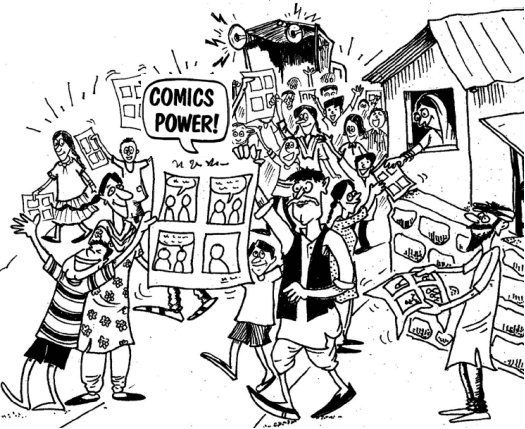
But comics need not necessarily confine to the comedy genre. Can they be used to communicate an issue, a cause or a fact? World Comics India, led by Sharad Sharma, is doing exactly that – using the power of comics to bring about a social change!

World Comics India is a collective of cartoonists, media persons and grassroots activists. This organization makes use of comics to serve as a communication tool and as a mode of self-expression in remote areas of not only India, but many countries in South Asia.

Sketch of a Village Well

Sharad Sharma, who leads World Comics India, is a cartoonist from Jaipur and has initiated numerous workshops where cartoons and comics are used to spread awareness. A novel idea indeed, considering that comics can easily cut across language barriers!

One of their campaigns was the Girl Child Right Campaign which aimed to address the issue of female infanticide in the region of Western Rajasthan. Here, they trained children and adults in comics making. These trained people in turn created over 300 comics focused on the girl child’s rights. World Comics India then conducted a road-based tour with all this material which was distributed to various villagers and local leaders. You can view all the comics created as part of this campaign here: Girl Child Right Campaign Comics

Similarly, they had also initiated a campaign against corporal punishment in Uttar Pradesh. Students of a school in Maharajganj used comics to spread awareness amongst teachers that punishment by beating is not really the right way to discipline children. Details of this campaign available here: Corporate Punishment campaign.

Their website is comprehensive with a lot of material available for people and organizations to make use of. For instance, the entire manual on how to go about creating these comics is available in both English and Hindi (both files are about 2 MB each).

If interested, you can download a series of videos available on their website which showcases how the various campaigns were initiated and also on how World Comics India trains people in the art of comics making! Click here to view and download all resources related to World Comics India, including a book written by Sharad Sharma and Leif Packalen titled “Grassroots Comics – A Development Communication Tool”.

For contact details, please visit their website www.WorldComicsIndia.com

Pointer to WCI provided by Sunandini Basu of Inktales

Protecting Our Heritage With No Strings Attached

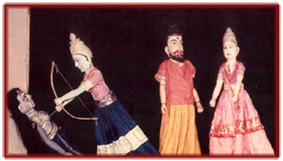
Remember the time you saw those magical figures dressed in a riot of colours and dancing to the tune of a lively music? Or when you felt immense joy and sadness as you watched them narrate the story of the charming prince, in their own animated way? Many believe India to be the birthplace of puppetry, with crude specimens found in the Harappa and Mohenjodaro civilizations as well. The art of puppetry as a divine creation or form of entertainment and illustration has found widespread mention in many ancient scriptures and literary works including the Mahabharata, Gita, and works of Kalidasa and Patanjali.


It is a known fact that this ancient art is dying a slow death due to neglect and more sophisticated forms of entertainment. Puppeteers find it difficult to earn a living and feed their families just by giving puppet shows as there is hardly any audience left. It would be very rare to find a puppet show these days, and is only seen sometimes in fairs that try to promote traditional Indian art forms. However, Press Trust of India reports in NDTV.com the good news that there are slum children of about 2,600 families in Delhi, who have taken on the responsibility of keeping puppetry alive.

This classical art form, however, has been kept alive by children of around 2,600 families from the slums of Delhi, who put up shows under the banner of Kalakar Vikas School.

Hailing from Rajasthan, Gopal, says he wants to show this art form to a much larger urban audience, who in his opinion, are not very much aware of puppetry.

Gopal’s ambition is echoed by Lakshmi, a 14-year-old from a village near Delhi, who says the urban audience needs to know more about this almost-dying art form.

“Urban people are not very much aware that this art form is almost on its deathbed. We are struggling to keep it alive, but we are ready to do anything for it,” Lakshmi says.

Their efforts are encouraged by the Indian Council for Cultural Relations (ICCR), as it has recently released a journal with the focus on puppetry, and The Union Internationale de la Marionette (UNIMA). It is touching to see these children with very few means of livelihood taking an active step in the conservation of an Indian heritage, a step that many affluent people would also not dare to take. The passion and optimism of these kids is a lesson to most of us who hesitate to protect what we know is valuabe and on the verge of being lost to us forever.

 

Read the complete article here.

Image Courtesy: PuppetIndia.com

Tribal Art and Computer Animation

Finally, we are beginning to see some convergence of two ends of the spectrum. The technology behind computer animation is now being introduced to help bring out the native artistic skills of tribals from various regions of the country.

Shruti Chakraborty writes in this article in the Mint, titled “Technology helping bring tribal art to life”.

Excerpt:

Gond tribal artist Gariba Tekam had never even seen a computer till two weeks back. Now, he’s working with technology to bring his images to life.

As he paints a blue fox on a piece of paper, part of the storyboard for an animation film on a squirrel’s dream, Tekam says he is excited to help one of the many folk stories from his Patangarh village in Madhya Pradesh reach a wider audience.

The artist’s quantum leap into computer technology comes after two days of not-so-intensive training, part of the two-week animation workshop conducted by the Adivasi Arts Trust, or AAT, at the Indira Gandhi National Centre for the Arts, or IGNCA.

As of now, the program has on board tribals from three regions of India – the Gonds from Madhya Pradesh, Santhals from Jharkhand and West Bengal, and Meiteis and Thadou Kukis from Manipur.

To know more about how the project is being implemented and the genesis of this wonderful idea, please read the complete article here.

Calendar

September 2010
M T W T F S S
« Aug    
 12345
6789101112
13141516171819
20212223242526
27282930  

Recent Comments

PROMOTION

"Neumonia and Other Sketch Stories" - A collection of sketch stories. Download the e-book for free. Click on the book cover below.
"The observations are acute: the sound of high heels on asphalt, the bit about how all BPO employees lose their hair very fast are spot-on. This book is a better, shorter alternative to any Sunday movie on TV. It's a little jewel" - Hindustan Times