Innovation: Biomass Cooking Stoves

In this article, we write about the Biomass Cooking Stove innovation that is being nurtured by the Villgro foundation.

Context and problems with LPG

Micro and small establishments that provide boarding services to 40 – 100 individuals in rural and semi-rural areas face the three pronged problem of not having the access, both financially and in terms of availability , to LPG, having to incur the costs of large amounts of biomass required to run their relatively inefficient stoves and dealing with the associated health impacts that inefficient, outdated stoves generate.
Unlike small households, micro and small establishments rely on purchasing fire wood and not on collecting biomass. These costs average around 2000 Rs. / ton. As such the inefficiency of stoves used by this category of users has a direct impact on their expenditure and thus on their income and savings. When compared to households these establishments utilize their stoves for much longer (upto 10 hours a day when catering to 100 customers) and thus the impacts on wood consumption and health issues are
exasperated.

Burning wood creates CO2 and other greenhouse gases. Establishments, based on size, generate between 20 – 80 tons of co2 a year. While small when considered at a national or global scale, this contributes to climate change in its own way.

Enter Biomass Cooking Stove, an innovation by Svati Bhogle of SustainTech India Pvt. Ltd.

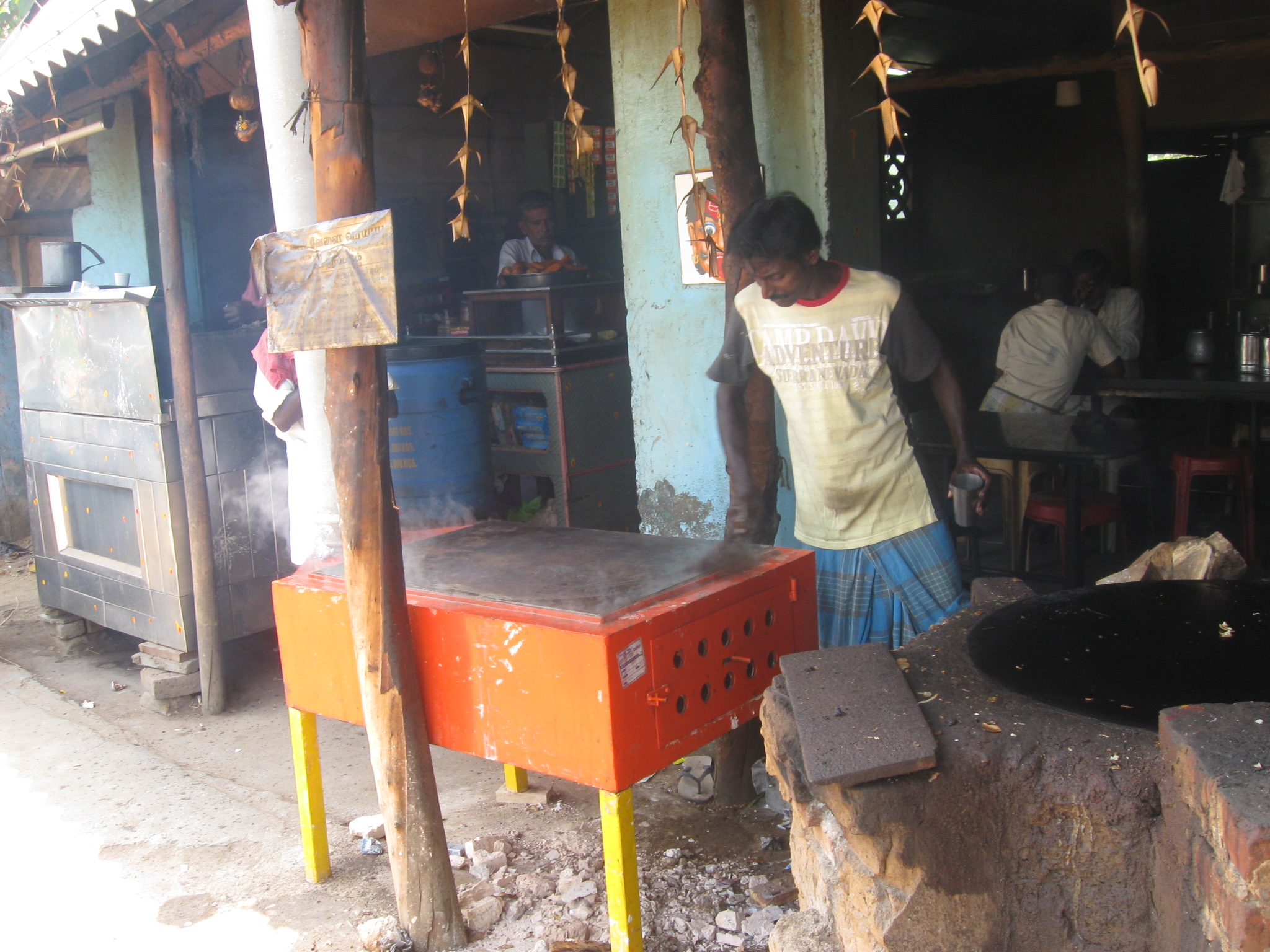
The Biomass Cooking stove is an application specific high efficiency wood burning stove specifically designed for a range of cooking needs. The innovation offers to the end user: saving in fuel costs, by being up to 50% more efficient than conventional stoves and improved health impacts. The features that make the stoves innovative are, optimum air fuel ratios controlled by efficient vents, well designed combustion chamber volume resulting in high combustion and heat transfer efficiencies, good insulation to prevent losses to the walls and an optimally designed chimney to vent the flue gases away from the breathing zone of the cooks and designed to reduce heat losses to the atmosphere.

Salient Features

  • High efficiency because of controlled burning, good air fuel ratio
  • Ability to regulate air supply and hence the fuel burning rate
  • Use of grate for good combustion
  • Good insulation and a uniform temperature profile across the plate because of staggered finning of the tava (flat plate). This has been designed so that one side of the tava uses preferentially radiative heat and the other side convective heat obtained by burning of wood on a grate.
  • Increasing the velocity of the flue gases towards the end of the plate, good insulation and an optimally designed chimney

Who is impacted and how?

Owners of micro and small boarding establishments, including semi-portable food vendors will be impacted. This covers a range of individuals with daily revenues between 500 to 5000 rupees per day. A market survey revealed that the total number of tea shops, small & medium hotels and street food vendors to be 73,650 in the state of Tamil Nadu alone.
On the lower end of the economics scale – this includes street side food vendors who spend considerable amounts of their income on firewood. These individuals were shown to spend upto 30,000 Rs. annually on firewood with monthly take home incomes of around 7000 Rs. On the higher end of the economics scale – this includes proprietors of small size ‘hotels’ catering to the needs of approximately a 100 customers a day.

Environmental, social and economic benefits


SustainTech India Pvt. Ltd. (SIPL) is reaching out to the needs of a fuel stressed segment of society – initially the street food vendors, who operate on push carts and where cooking is done inside the cart or on railway platforms, roadside shops and small hotels who with a roof and some seating capacity.
A survey conducted shows that these stoves are in operation for about 10 hours every day and each unit caters to about 100 clients every day. The 65,000 fuel efficient wood burning stoves (considering only the tava, frying stoves and tea kettles) that would be sold by SIPL in the first five years would therefore offer a safer, cooler and healthier working environment to at least 65,000 cooks and 6.5 million people who would eat
around these stoves every day. India has a high incidence of respiratory ailments and a smoke free working environment would reduce the medical expenses of the affected people working around wood fires.
The survey data also shows that 38% of the street food vendors and tea shops use kerosene for their cooking needs. Very limited kerosene is available in fair price shops and this is inadequate. Very often the sector uses unfair means to procure kerosene creating stress and tension besides eroding the profitability.

A Frying Stove Biomass based


Moving to a biomass stove would reduce the stress associated with procurement of kerosene, improve profitability of the business and show that it is possible to replace a fossil fuel with a renewable energy source.
At the global level the movement to a fuel efficient wood stove would significantly abate CO2 emission. A survey conducted in the project area shows that stoves are in use for about 8 -14 hrs every day and for 300 -350 days in a year. Data has also been collected about fuel consumption patterns in conventional stoves and performance of improved stoves tested and some of them certified. With a projected stove life of 5 years, the carbon abatement potential of the venture through installations in the first 5 year planning period would be 3.7 million tons of CO2. (1 kg of firewood saved = 1.5 kg of CO2).
Firewood is purchased by the end users of SIPL products at Rs 2000 / ton. The saving in fuel costs, because of energy efficiency should enable the end user to payback the cost of the stove without financial stress in 12- 18 months. Each stove purchased would on an average save Rs 20,000 – 30,000 of fuel cost every year.

The enterprise projects that through its intervention and in their life time, the stoves installed in the first
5 years period, it would conserve Rs 4000 million in fuel costs thus creating wealth for a very needy community.

SustainTech is now being incubated by Villgro. Villgro is a not-for-profit company empowering rural development by identifying and incubating innovations that could be translated to market based social enterprise models thus impacting thousands of lives. In efforts to impact rural life, VILLGRO actively promotes social entrepreneurship and works with different stakeholders to create and support an eco-system that empowers social entrepreneurship by means of seed funding, mentoring, networking and recognition. Villgro has impacted over 360,000 rural users with technology & solutions reaching the grassroots. Villgro has identified and activated more than 2000 social innovators.

Invention: Pin Pulverizer by Mr. Vivekanandan

In this article we bring to you an interesting invention by Mr. Vivekanandan, who is now being mentored and assisted by the Villgro foundation. Going by the good old adage ‘necessity is the mother of invention’, the device was invented by Mr. Vivekandan because of a real-world problem that his fellow villagers faced.

The Problem

Chili and coriander powder are so central to South Indian cuisine, that village residents will travel 25 km by bus to get it ground. They are forced to do this because the existing machines to grind chili and coriander are usually very large, have high installation costs, and use too much power to be suitable for rural areas.

Mr. Vivekanandan’s Solution

Mr. Vivekanandan’s innovative solution was a pin pulverizer that was modified for small capacities, yet could still grind chili and coriander. The material is centrally fed into the pin pulverizer’s milling chamber, which consists of two discs with pins: one is stationary and the other is rotary. The material that passes through the space between the stationary and rotary pins gets scissored, and converted into a fine powder. The perforated screen at the bottom filters the powder, and it is discharged through it.

When Mr. Vivekanandan applied to Villgro, pin pulverizers that could grind spices were already being manufactured with a capacity of 150 to 4000 kg/hr. A pin pulverizer that had a capacity of 30 kg/hr was also available, but it was only able to grind cereals.

Mr. Vivekanandan’s journey with Villgro literally began with a journey. He came to know about Villgro and its activities when he accidentally met an employee of Villgro on a train. At this point Mr. Vivekanandan had already invested Rs. 8 lakhs (approximately US$ 18,700) of his own money, and had created a 3 HP pin pulverizer without any external help. He thought he had solved 90% of the problems in grinding chili and coriander, and had manufactured 100 machines. But of these only 20 were sold. Even worse, three quarters of these machines were returned because the chili and coriander did not pass through the screen, and because they created too much dust. The work came to a standstill, and did not resume until almost a year later, when he was introduced to Villgro.

Villgro tapped several different resources to work on this problem. These were the technical expertise of their own staff, the assistance of a consultant from TANSTIA-FNF, Mr. Ashok Iyengar, and InnoCentive, an “open innovation” company that opens up research and development problems for anyone to solve. The solution arrived at was to increase the speed of the rotor to 6600 rpm.

While increasing the speed of the rotor is a seemingly simple solution, for Mr. Vivekanandan the key realization was that the chili and coriander were getting stuck in the screen not because of their high fiber content, but because of the speed of the rotor. In addition, Mr. Vivekanandan was concerned that to run the rotor at higher speeds, he would need much more expensive bearings. Consequently, if the cost of the machine increased, then grinding chili and coriander could not become a viable income generating activity for rural women. Mr. Vivekanandan is quick to emphasize that the main assistance that Mr. Iyengar provided to him was in giving him greater confidence, and in allaying his fears.

Mr. Iyengar first assisted Mr. Vivekanandan in producing a 5 HP, 3-phase machine, because his machine could not initially be run at the increased speed on 3 HP. However as in rural areas the preference is for a 1 HP, single-phase machine, Mr. Vivekanandan subsequently reduced his machine’s weight, wall thickness, size and diameter of the stator and rotor so that it is suitable for rural areas. Mr. Vivekanandan has also attempted to bring the cost of the machine down to cater to rural needs by focusing on the types and amount of materials used. However he has maintained the quality of the essential components such as the bearings and blades.

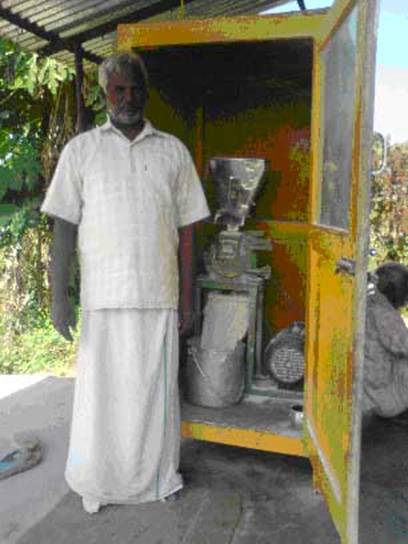
Below is a picture of a villager using the pin pulverizer. Fantastic innovation which is sure to benefit hundreds of villagers!

Note about the Villgro Foundation: Villgro is a not-for-profit company empowering rural development by identifying and incubating innovations that could be translated to market based social enterprise models thus impacting thousands of lives. In efforts to impact rural life, VILLGRO actively promotes social entrepreneurship and works with different stakeholders to create and support an eco-system that empowers social entrepreneurship by means of seed funding, mentoring, networking and recognition. Villgro has impacted over 360,000 rural users with technology & solutions reaching the grassroots. Villgro has identified and activated more than 2000 social innovators.

Calendar

September 2010
M T W T F S S
« Aug    
 12345
6789101112
13141516171819
20212223242526
27282930  

PROMOTION

"Neumonia and Other Sketch Stories" - A collection of sketch stories. Download the e-book for free. Click on the book cover below.
"The observations are acute: the sound of high heels on asphalt, the bit about how all BPO employees lose their hair very fast are spot-on. This book is a better, shorter alternative to any Sunday movie on TV. It's a little jewel" - Hindustan Times