The Tree Planter

pine-2Global Warming. Unemployment. How do you come up with a solution that addresses both these issues? S M Raju, a civil servant in Bihar has done just that. Raju has started a campaign to encourage unemployed village folk to start planting trees. This campaign has been linked with the government’s NREGA (National Rural Employment Guarantee Act) and thus the village people earn money by planting these trees.

Amarnath Tewary writes in this article at the BBC:

An Indian civil servant, SM Raju, has come up with a novel way of providing employment to millions of poor in the eastern state of Bihar.

The article quotes that about 44% of Bihar’s population is under the poverty line. And Bihar has not been able to successfully spend the NREGA funds allocated to them mostly due to lack of awareness. Here comes Raju’s idea of bringing in tree plantation as part of NREGA.

Raju’s program has brought in significant benefits, as he says:

“So the idea struck to my mind, why not involve families below the poverty line in social forestry and give them employment under this scheme for 100 days?

“Under the scheme, each family can earn a minimum of 10,200 rupees ($210).”

Read the complete article here, which lists how Raju conceptualized and executed this successful idea. A special thanks to reporter Amarnath Tewary for writing about this.

Link to original article: http://news.bbc.co.uk/2/hi/south_asia/8257563.stm
Link submitted by: Deepak and Prakash

English Radio Lessons – What an Idea!

Indian television afficionados may have come across an advertisement of a mobile service provider depicting how a mobile phone could be used to spread education in remote areas. It got us interested and we wanted to see whether such an idea (no reference to the company!) was actually being implemented. After some not-so-intensive news searching, we came across an article by BBC India’s Amarnath Tewary which describes how the radio is being used in Bihar to teach English to school children.

The Bihar Education Project, in collaboration with the Education Development Center (a US-based organization), launched this innovative teaching idea in order to improve literacy of the state. Bihar currently has a literacy percentage of only 47%.

Amarnath Tewary reports:

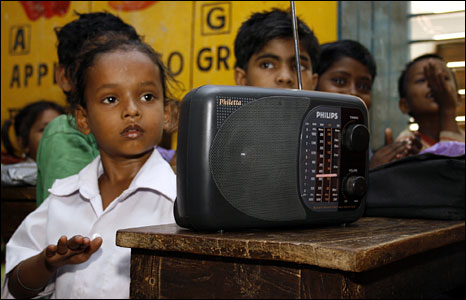
The students are looking inquisitively at a radio set perched on a plastic chair in the middle of the classroom in the capital, Patna.
They are all waiting for a new English lesson to begin – on the radio. 

So, for half an hour, four days a week, millions of primary students in Bihar today learn English through this radio lesson.

The year-long interactive radio lessons are being broadcast by the four regional state-run All India Radio stations. The lessons cover seven million students attending 65,000 primary schools in all the 38 districts of the state.

And what does a student have to say about this?:

“It is very easy to learn English on radio. Every day we wait for this class. Even if the teacher is not in the class we learn and enjoy the programme,” a student, Sakshi Kumari, said. 

The state government has granted a 1000 rupees to every school to enable them to buy a radio. And the benefits of such initiatives in Bihar are told in this para:

Interestingly, backward and dirt-poor Bihar appears to be a trend setter here – a recent federal government report found that school students in the state are now faring better in English and mathematics than anywhere else in the country. 

The article is very well written and also gives you the perspective of the teachers in these schools. It is truly inspiring to see such initiatives being taken in the field of education, which is perhaps one of the most important areas requiring development in our country.
Last, but not the least, we couldn’t help but add the punch line – What an Idea!

Image courtesy: Prashant Ravi from BBC News

A Flood of Unlikely Heroes

They are afflicted with polio and are disabled. Yet these two casual labourers and friends – Amrendra Shukla and Ravi Paswan – have saved more than 40 people from getting swept away in the disastrous floods of Bihar. The old adage “Where there’s a will, there’s a way” has never been more beautifully depicted as by these two brave souls, reported by Amarnath Tewary in BBC News:

“Before our eyes little children, women and elderly people were being swept away in the strong currents of the flood water,” Shukla told the BBC.

An idea came to him and Paswan to tie three empty drums together with thick bamboo sticks and then place a wooden bed on top.

They initially took six children on it for 3km (1.8 miles) in neck-deep water to reach a safer place.

Over three days they evacuated over 40 people – mostly children, women and elderly people.


The disastrous floods in Bihar has brought in its wake untold tragedy and hardships on people. However, from the wreck have emerged many heroes who never really had any intentions of becoming messiahs for the millions trapped in misery. It was circumstances and their inherent qualities that made them look inwards and turned them into great comforts for the suffering masses.

Aastha Volunteers

Aastha Volunteers

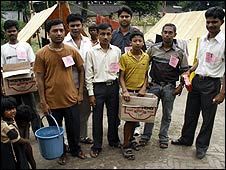
Another one of them is Anand Mohan, a recent graduate of Indian Institute of Technology (IIT), who intended to return to his home in Bihar for a few days before joining a multinational in Australia. Destiny had something else in store for him, and when he came to Sharsha, he found his hometown ravaged by the floods.

Mohan could not resist, and plunged into the relief operations. He was soon joined by more like-minded people, one of which was Ravi Verma, and together they formed a group called Aastha (Faith) Volunteers. They started collecting donations from friends and local people and providing help and support to the people in the relief camps. Aastha now has a team of 15 dedicated volunteers managing more than 300 flood victims.

“Now we do not want to go anywhere else. Here we’re getting everything from these people. They’re taking care of us more than the government or other agencies,” said Sanjay Kumar Mukhia from the neighbouring district of Madhepura.

He lost 16 members of his family in floods caused by rampaging rivers.

“My three year’s old son survived only because of milk supplied by these bhaiyas, (brothers),” said another flood victim, Ghuran Ram.

Vijendra Rai’s three children were suffering from acute diarrhoea – but they all survived thanks to timely medical help from Aastha volunteers.


What is even more admirable is the way these youths shrug off media attention that most other proclaimed organizations, government bodies and media houses clamour for. Theirs is the spirit that The Better India strives for.


Read the complete BBC article here.

Image Courtesy: BBC News

Link Courtesy: Ramanand Nayak. Thanks.

Calendar

September 2010
M T W T F S S
« Aug    
 12345
6789101112
13141516171819
20212223242526
27282930  

Recent Comments

PROMOTION

"Neumonia and Other Sketch Stories" - A collection of sketch stories. Download the e-book for free. Click on the book cover below.
"The observations are acute: the sound of high heels on asphalt, the bit about how all BPO employees lose their hair very fast are spot-on. This book is a better, shorter alternative to any Sunday movie on TV. It's a little jewel" - Hindustan Times