









Neonatal Care in India: Raising a generation by raising awareness
Every seven minutes, a woman in India dies due to pregnancy-related complications. Over a million babies born in the country die within their first month of life. India has the
Every seven minutes, a woman in India dies due to pregnancy-related complications. Over a million babies born in the country die within their first month of life. India has the unfortunate distinction of claiming more than a quarter of the total newborn deaths in the world. The majority of these deaths occur in rural areas where poverty and lack of knowledge about proper maternal and child health care are the real cause of these fatalities.
The Indian government has come up with schemes such as the National Rural Health Mission (NRHM) and the soon-to-be-launched National Urban Health Mission (NUHM) to address this dire situation. Both schemes give high priority to the issue of maternal and newborn health for marginalized communities, and seek to improve the availability of and access to quality health care for those at the lowest rung of the socio-economic ladder. Additionally, government programs such as the Janani Suraksha Yojana incentivize delivery in hospitals by encouraging mothers to opt for institutional deliveries.
Effective development communication programs can play a pivotal role in bridging these knowledge gaps by identifying barriers to behavior change, analyzing these barriers, and developing original techniques to overcome them.
AKHA
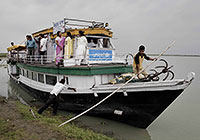
For instance, in Assam, a collaboration between the Indian government, UNICEF, and local bodies is using a boat called Akha to reach underprivileged indigenous tribes that inhabit geographically isolated sandbars and islands called chaporis. The chapori residents, who live near the lifeline of Assam—the Brahmaputra river, are often cut off from accessing health care facilities due to floods and other natural hazards. What’s more, awareness about maternal and child health care is all but drowned out by the other concerns for survival that face this group.
The Akha, which comes equipped with medical staff and communications materials, makes visits to these isolated regions with the mission to regularly provide facilities for maternal and child health as well as promote awareness about health-seeking behaviors. Findings suggest that the service delivery undertaken by the boat, which has been continually expanding over the last few years, has dramatically improved thousands of lives. 71 percent of the chapori mothers sought some form of antenatal care during their last pregnancy; of these, 42 percent sought care from the Akha.
This is one example of how an intervention tailored to the specific needs of a community can raise awareness and create tangible change.
SURE START

Another example is the work done by a project called Sure Start—an initiative based at PATH, an international not-for-profit organization supported by the Bill & Melinda Gates Foundation. The project is working with rural communities in Uttar Pradesh and settlements of marginalized people in Maharashtra to help mothers and their children to survive and stay healthy.
The project’s communications program is innovative in its efforts to raise awareness and interest about maternal and child health care issues. In villages, for example, the “letter from an unborn child” campaign reached out to 40,000 fathers-to-be, educating them about the importance of taking care of their wives during pregnancy. In both Uttar Pradesh and Maharashtra, the program uses interactive and entertaining tools including dance, music, theater, and games to create awareness.
Mr. Nirbhay Singh, the elected head of one of the villages in Uttar Pradesh where Sure Start operates, estimates that since the program began in his village in 2008, 70 to 75 percent of adults in the community have become aware of safe delivery practices and the vital importance of ensuring access to maternal and child health services. One result is that payments under the government’s Janani Suraksha Yojana (a scheme that incentivizes institutional delivery) have increased alongside the growing awareness about the health benefits of giving birth in hospitals.
In this way, projects such as these use customized communication techniques to raise awareness of maternal and newborn health issues, thus helping local communities benefit fully from existing government schemes. It has often been said that knowledge is power, and the projects mentioned above give that power back to the communities they work in.
Sure Start works to educate women in India on maternal and neonatal health. Sure Start, an initiative by PATH, supported by the Bill & Melinda Gates Foundation works to promote safe childbirth practices in India.
Connect with PATH at:
Facebook: http://www.facebook.com/pages/Sure-Start-Project-by-Path/178629192101
Twitter: http://twitter.com/pathsurestart
Article courtesy: Vikas S from PATH Sure Start. Thanks Vikas!



This story made me
 97
97- 121
- 89
- 167









 Home
Home
 Read
Read
 Watch
Watch
 Contribute
