An Urban Bird Sanctuary

Feeding Birds

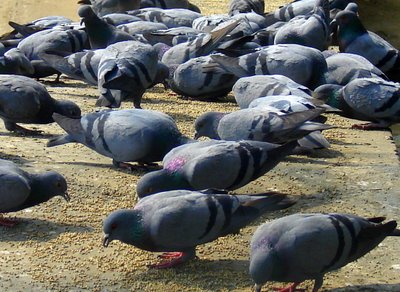
A few residents in a locality in Bangalore have created a safe haven for birds to nestle and feed. For over a period of 16 years, almost 30 households of 5th Cross, Pipeline on Magadi Road have been actively involved in feeding over 50 kilos of food grains to hundreds of birds daily. This has helped to create a ‘sanctuary’ in the heart of the city, where many species rendered rare in other urban areas, find a habitat. Subhash Chandra N S and Chethan Kumar write about this citizen initiative for the Deccan Herald News Service:
Not just a few but hundreds of various kinds of birds come to this citizen-created ‘sanctuary’. “There are parakeets, sparrows, pigeons, mynas and other birds which descend at a self-scheduled time, once in every mornings and evenings”, said C Umadevi, the lady who began this noble work. Over a fifty kilos of food grains goes to the chirping friends every month, a ritual in practice for the past 16 years.

Despite being a densely populated area full of traffic and people, the residents have taken care that the avian visitors are not disturbed and receive their daily due on time.

“We have restricted people from going up to the terrace when the birds are there,” says another lady. The practice has resulted in holding back sparrows, almost extinct in urban environment. “More than 20 are coming here now while the numbers were much more earlier” a resident informed.

The simple initiative of these residents has gone a long way in teaching habitat conservation and co-existence among species, besides the added benefit of nurturing fast disappearing species in the urban landscape. While we applaud their efforts, we urge all our readers to adopt this easy and do-able practice in your daily lives. The pleasant chirping of the sparrow sitting on your ledge will be worth it.

Read the complete article here.
Image courtesy: Pigeons by Pratosh Dwivedi at imgoftheday.blogspot.com

On Children’s Day – An Unusual Gift

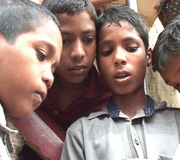
On Children’s Day, what better gift can we give them than the gift of a voice and representation? This is what about 65,000 children enjoy in 4 districts in Karnataka at the Makkala (children) Panchayats. Aged between 6 and 18, these young leaders are being groomed to understand their rights and participate in the democratic process of the country.

Initiated in 1995 by Concerned for Working Children (CWC), an NGO, in collaboration with the Ministry of Rural Development and Panchayati Raj, Government of Karnataka, the Makkala Panchayats allow children to make informed decisions on issues that concern them. Malathi Belur reports in Deccan Herald:

As part of Makkala Panchayat, the voters elect candidates aged between 12 and 16, who in turn hold Grama Sabhas and participate in Gram Panchayat meetings.

If you thought these little administrators could be sidestepped, think again. For, they are armed with information, data from research, surveys and an agenda chalked out at the prior meeting of Makkala Gram Sabhas.

Apart from the Namma Sabha and Bhim Sangha, the Makkala Panchayat gets a backing from the Task Force which comprises government functionaries, elected representatives, local NGOs and other organisations.

Not only are these children raising and solving their concerns, they are also bringing about a world of change in the community and its development. They have successfully campaigned for various issues like facilities for the disabled, proper distribution of ration cards to the poor, basic amenities in schools, etc. With their fun-filled and lively way of working, they have infused new life and vitality in the proceedings of the sabhas and panchayats.

Wondering how the elections are held?

Elections held to the Panchayats are better than those that are held to Gram Panchayats due to their non-partisan nature, compulsory voting and reservations for working children, students, school dropouts, migrant children, the disabled and girls. However, each Panchayat has devised its own system based on local needs. For example, while in Kundapur girls are given 65 per cent reservation, in Bellary, seat sharing between girls and boys is 50:50.

What about corruption?

Elections are held in schools by the election committee with the help of head masters, teachers and anganwadi workers. In one instance, when a member of the Panchayat failed to attend meetings, he was sought an explanation. On finding the reason invalid, he was recalled and by-election was held to the post. Of course, earnestness of these kids would make any adult feel shame for not being able to recall the corrupt ministers in our political set-up.

This unique initiative by the CWC and Government of Karnataka is a wonderful model to make responsible and dedicated citizens out of the children of today, and a great training ground for future leaders of the nation. It also stems the tendency to complain about inadequacies in the system, and instead, be a part of the system and work to improve it from within. The Makkala Panchayats could surely serve as an example for the role played by an ideal democracy to the rest of the country, as to the rest of the world, and should be given due recognition and encouragement. There are a lot of lessons to be learnt here.

Read the complete article here.

Image Courtesy: Sonk Films

The Gift of the Goat


When the US dropped bombs on Hiroshima and Nagasaki during World War II, nobody would have imagined that more than half a century later it could have an effect in bettering the lives of a couple of hundred women in the Gulbarga district of Karnataka. But this is the case under a new scheme called “Pass on Gift” launched by the ‘Bayalu Seeme Rural Development organization’ (BSRDS), inspired by a similar initiative launched by an organization named Hyper after America received widespread criticism for its actions.

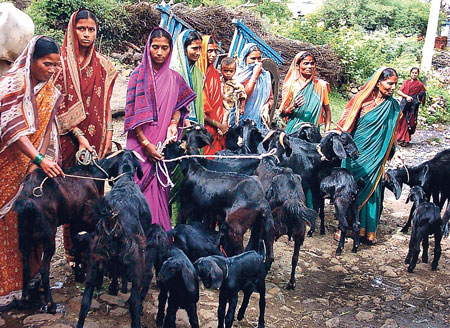
This unique and innovative has been introduced in 6 villages in the poor districts of Gulbarga. Under the scheme, 3 groups of six women have been identified in each village. The first group in each village was gifted a goat in the first year. Within a year, the goats gave birth to 7-8 lambs each. Each of the women beneficiaries then gifted a lamb to one of the identified members of the next group the following year. This is to continue year after year, so that at the end of 3 years, 108 families have already benefited by this Gift of Goat.
The improvement in the financial conditions of these women and their families has been tremendous. This can be guaged from Anand Teertha Pyati’s report in Deccan Herald, which says:

Gangu Bai, who had got a goat in the first year, now owns more than 25 goats. By selling some of them, she has bought a buffalo. “Don’t tell anyone. I’ve purchased one tola gold also,” she says, sounding very secretive!
Spending thousands of rupees on children’s school fees, text books and uniforms, Sangeetha has bought a cow worth Rs 10,000.

With the help of the ‘Pass on Gift’ scheme, 108 families in six villages are getting a regular income now. Their livelihood has been taken care of. BSRDS has spent about Rs 82,000 to gift goats to the first batch. Now the business has reached lakhs of rupees. Observing this success, the State Bank of Hyderabad has come forward to give loans to these women to start construction of a cow shed, a stitching centre, and so on.

Read more about this brilliant scheme and its resounding success here.
Image courtesy: Deccan Herald Gallery

Calendar

September 2010
M T W T F S S
« Aug    
 12345
6789101112
13141516171819
20212223242526
27282930  

Recent Comments

PROMOTION

"Neumonia and Other Sketch Stories" - A collection of sketch stories. Download the e-book for free. Click on the book cover below.
"The observations are acute: the sound of high heels on asphalt, the bit about how all BPO employees lose their hair very fast are spot-on. This book is a better, shorter alternative to any Sunday movie on TV. It's a little jewel" - Hindustan Times