Radio Bundelkhand – Giving Voice to the Voiceless

Azadpura is a village in Bundelkhand region. This area faces acute water scarcity and one problem that the women faced was a faulty well which required urgent repairing. The women aired this problem on Radio Bundelkhand and within four days the concerned authority replaced the missing wheel of the well. This is the power of Radio Bundelkhand, an initiative of Development Alternatives.

Community Radio for facilitating dialogue and interactive communication

The purpose of setting up Radio Bundelkhand, as identified with the help of our communities in the radius of the radio station, is to work along with them to use this communication medium to create awareness, give information, participate in local self governance and provide entertainment – all based on requests and feedback from the community. The audience includes the communities in the radius of the broadcast range – with special attention to women, youth and the marginalised groups.

 
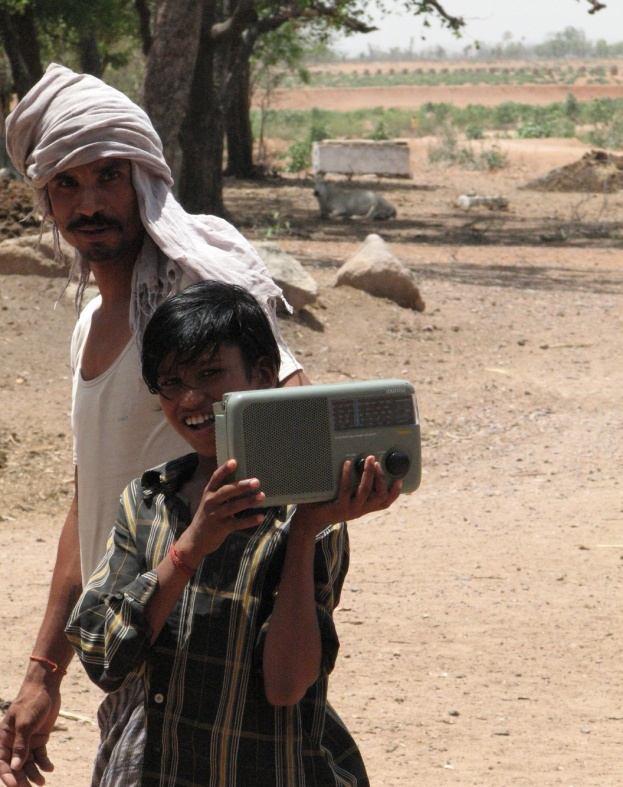
Listening to Radio Bundelkhand

Listening to Radio Bundelkhand

Community Members on the Radio

Community Members on the Radio


The community and DA, jointly manage the station. There are five community reporters and six community coordinators. The villages these reporters represent are Azadpura, Ramnagar, Sitapur, Basova, Bagan, Bhagwantpur, Ghatao, Jamuniya, Gujerra Kalan, Mathrapur and Ghatao. There is also a Management Committee comprising the Sarpanch (elected village-head) of Basova Village, doctors, farmers and Self Help Group members.

Until now, Radio Bundelkhand has the longest duration of programming of four hours a day, seven days a week, in Bundelkhandi and Hindi amongst the government licensed community radio stations in India. The Government of India has given licenses to several NGOs throughout India to start community radios in their project areas. DA is one of the first to set up such a radio with the communities it has been serving for more than two decades in the Bundelkhand region.

The communities have decided that they would like information related to employment and livelihood opportunities, development of women, girl’s education, legal rights, farmers’ issues, training, their culture and history, how to ensure the availability of basic infrastructure such as water, energy and roads, development issues, and any other information sought by the communities. The broadcast timings in the morning and evening have been selected by the communities, with the women preferring the morning and the men the evening.

Programming Content on Radio Bundelkhand
Vandana –Devotional songs broadcast every morning.
Khet Khaliyan – It includes the Jhansi Mandi (unorganized market) prices for farmers so that community gets all the information related to agricultural products. Bundelkhand Radio also
broadcasts discussions about agriculture issues like how to protect seeds, crops & vegetables
from insects. Experts answer question asked by the farmers.
Bal Bandhu – Especially for school-going children. Moral stories, poems and jokes by school
children are included. Story telling through the Radio Jockeys is also a part of this programme.
Bundelo harbolo ke- This is about the Freedom Fighters of Bundelkhand. Stories of the freedom fighters & songs related to freedom fighters are also broadcast.
Aas Paas – In this programme Bundelkhand Radio broadcasts information on Right to
Information (RTI) and any other problem.
Mere Bundeli Mere Geet – is a listener’s programme in which they get the opportunity to listen to their choice of songs.
Amma ke Chauki Se – In this programme community women give their ideas on home receipes and step by step instructions for preparing the dish.
Nuskhe Nani Dadi Ke – In this programme older woman give tips on using home remedies or
Desi nuskhe for common ailments and diseases. Also, give tips of using simple home remedies and alternative herbal medicine, available from the average kitchen shelf.
Radio Drama – On every Sunday Bundelkhand Radio broadcasts a radio drama. In this
programme reporters discuss an issue and convey the messages related to social issues like
dowry, female foeticide, importance of education etc.
Sathin – Sathin is a special programme for women. Women from the community tell their story. They discuss the struggle in their lives and success story too. These women also share their
feelings what they want or wish for themselves.
Chhotou Kam Badou Munafou – This programme is for those people who want to do small business. Small entrepreneurs give tips to take up small business.

The programming, based on issues and content identified by the communities, is broadcast in the formats which they have preferred, that include the use of traditional Bundelkhandi songs, folk music and nataks, discussions, reports, commodity prices, phone-ins, experts speak, coverage of events in villages, jokes and satire, listeners’ letters and feedback. The Wireless Operating License was issued on July 31st, 2008 and the first transmission took place on August 15 2008 with the broadcast of the national anthem. Meanwhile the selected community reporters were trained over three months and a woman from Sitapur village inaugurated the station on the eve of Diwali. Community radio broadcasting/narrowcasting has allowed the rural poor to develop their communication in a language they understand. Community radio fosters debate on issues, facilitates access to government, decision-making and helps community members to organise themselves and evolve to manage their own affairs. Radio Budelkhand is characterised by its signature tune and jingles which declare that it is “Apna Radio Apni Baatein” – Our radio Our conversations.

Reaching our communities

The reach of the community radio is in a wide range of approximately 5-10 kms and 25 villages with a population of 15000 in the coverage area that are benefiting through the infotainment-based programmes. So far, Radio Bundelkhand radio has penetrated to the rural communities settled in and around TARAgram Orchha like the villages of Gundrai, Chandravan, Bagan, Orchcha, Sitapur, Azadpura, Lachmanpura.

The targeted beneficiaries are the marginalised and poorest with special emphasis on women and the unemployed youth who are the most vulnerable but also the potential change-makers. By selecting women community reporters, marginalised community reporters in an average age group of 20 we hope to reach them better.
The Management Committee also has a woman self-help group head. DA aims to ensure the participation of local people for the programming, broadcast and management of the station by the community itself.

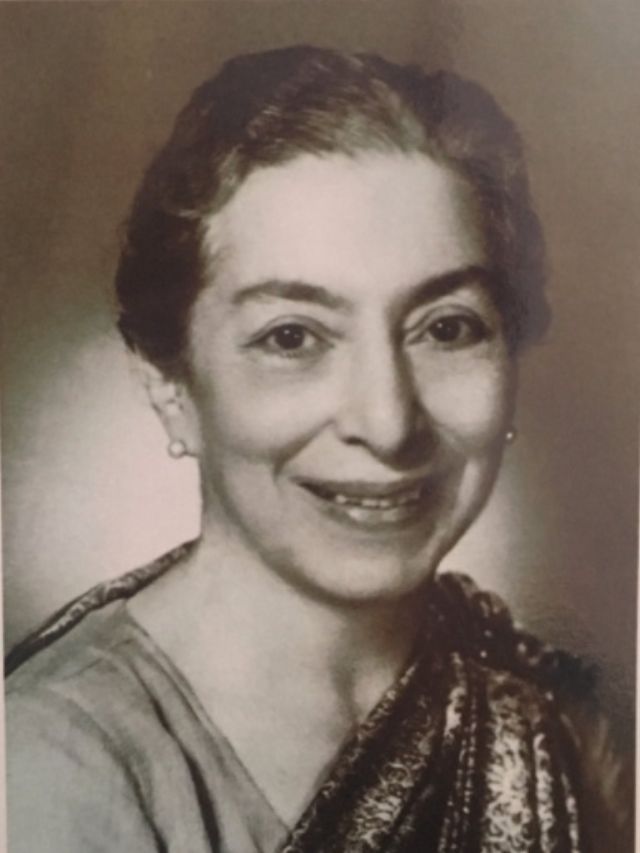
The above article was written by Indira Mansingh, Chief Advisor, Development Alternatives.

Thank you Purnima Gupta for sending this across!
Previous article of Development Alternatives – Click here.

English Radio Lessons – What an Idea!

Indian television afficionados may have come across an advertisement of a mobile service provider depicting how a mobile phone could be used to spread education in remote areas. It got us interested and we wanted to see whether such an idea (no reference to the company!) was actually being implemented. After some not-so-intensive news searching, we came across an article by BBC India’s Amarnath Tewary which describes how the radio is being used in Bihar to teach English to school children.

The Bihar Education Project, in collaboration with the Education Development Center (a US-based organization), launched this innovative teaching idea in order to improve literacy of the state. Bihar currently has a literacy percentage of only 47%.

Amarnath Tewary reports:

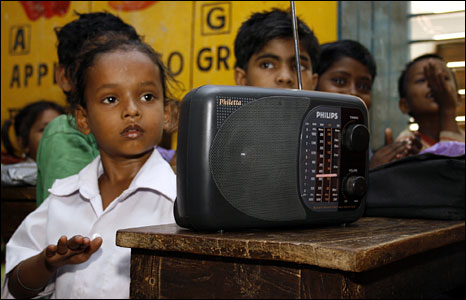
The students are looking inquisitively at a radio set perched on a plastic chair in the middle of the classroom in the capital, Patna.
They are all waiting for a new English lesson to begin – on the radio. 

So, for half an hour, four days a week, millions of primary students in Bihar today learn English through this radio lesson.

The year-long interactive radio lessons are being broadcast by the four regional state-run All India Radio stations. The lessons cover seven million students attending 65,000 primary schools in all the 38 districts of the state.

And what does a student have to say about this?:

“It is very easy to learn English on radio. Every day we wait for this class. Even if the teacher is not in the class we learn and enjoy the programme,” a student, Sakshi Kumari, said. 

The state government has granted a 1000 rupees to every school to enable them to buy a radio. And the benefits of such initiatives in Bihar are told in this para:

Interestingly, backward and dirt-poor Bihar appears to be a trend setter here – a recent federal government report found that school students in the state are now faring better in English and mathematics than anywhere else in the country. 

The article is very well written and also gives you the perspective of the teachers in these schools. It is truly inspiring to see such initiatives being taken in the field of education, which is perhaps one of the most important areas requiring development in our country.
Last, but not the least, we couldn’t help but add the punch line – What an Idea!

Image courtesy: Prashant Ravi from BBC News

Calendar

September 2010
M T W T F S S
« Aug    
 12345
6789101112
13141516171819
20212223242526
27282930  

Recent Comments

PROMOTION

"Neumonia and Other Sketch Stories" - A collection of sketch stories. Download the e-book for free. Click on the book cover below.
"The observations are acute: the sound of high heels on asphalt, the bit about how all BPO employees lose their hair very fast are spot-on. This book is a better, shorter alternative to any Sunday movie on TV. It's a little jewel" - Hindustan Times