Khabar Lahariya – A Weekly Newspaper in Bundeli

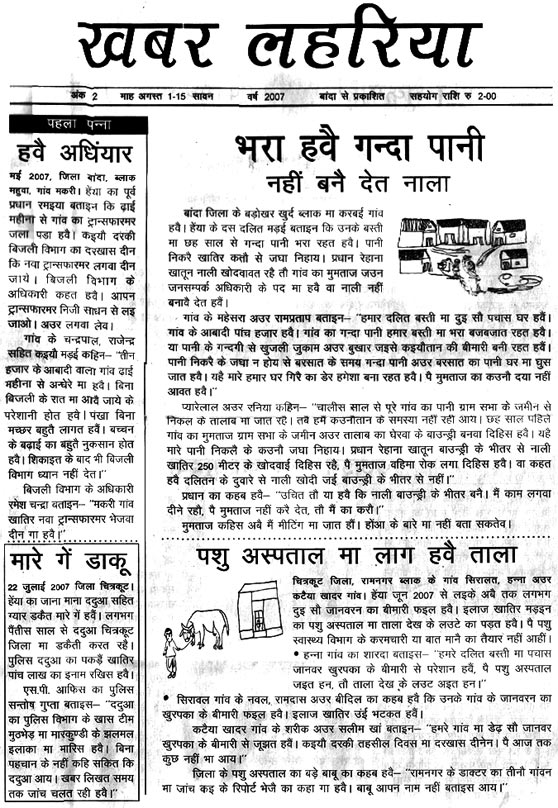
Khabar Lahariya a weekly newspaper in Bundeli (local dialect of Bundelkhand) is being run by a group of women from various sections of the society from the interiors of Chitrakoot and Banda in Uttar Pradesh. Their main objective is to reach out to the nearby villages and provide them with ‘infotainment’.

Despite having a limited exposure to the literacy and information, their ability to interact with various people in public sphere and coming up with innovative ideas is extremely remarkable. Their works have been acknowledged and credited by leading National Dailies including The New Indian Express, The Hindu, Hindustan Times, Tehelka and various other dailies and weekly’s.

In 2008, the Khabar Lahariya group registered themselves as an independent organization, Pahal. With the incredible support from Nirantar, which is an acclaimed centre for gender and education, Pahal has now found its place in rural women’s media collectives of our country.

Khabar Lahariya carries out news that is of primary importance to the masses in and around these areas. Although they do have sections regarding current affairs, national and international news, they strongly highlight the cases of violence against women, issues on Dalits and more. This 8-page newsletter also covers issues on institutions like schools, marriage, health care and more.

Although these journalists do not come from strong literary background, they do ensure the quality does not receive a set back. Significant efforts have been made in order to improve their technical skills, their reporting and writing skills and more. Apart from the above, they also encourage public interactions and gather inputs to cater to the specific needs of the women. Meanwhile, frequent workshops are also being conducted by these women to encourage more writers and volunteers to have an in hand practical experience of running a newspaper.

Depending on the need of the hour, they hold meetings at their editorial office to divide their beats and after enormous research and writing they go all the way to the nearest city Allahabad for printing.

Click on the image below to read an issue of Khabhar Lahariya:
khabar_lahariya1

These phenomenal revolutionaries, who have gone beyond their capacity to go on fields, have received the prestigious Chameli Devi Jain Award for Outstanding Woman Mediaperson. Also, three members of the group have received fellowships from the Dalit Foundation in 2004, for reporting on issues related to rights of the Dalit community.

Overwhelming technological cloud has also been bestowed upon the offices of KL as they now work on computers with broadband connections. The challenge of consistently making an outstanding appearance in the face of media and having an unbiased opinion regarding the political scenario of our country comes very easily to them. They aren’t restricted in writing what their leaders want them to write. They write information regarding subjects that pertain to them. Hats off to the women behind this initiative, they have managed to achieve what many of us with enough resources have been unable to do!

Read more details about Khabar Lahariya, including how the paper is produced, edited and distributed at Nirantar’s website: NIRANTAR

This article written by guest reporter Jheel Parekh.
All images courtesy NIRANTAR.

A Clean Play!

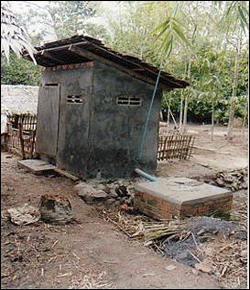
Sanitation and clean drinking water are serious issues. And what better way to convey such a serious message than with the help of humorous plays? This is exactly what the Public Health Engineering Department (PHED) in Assam has undertaken to spread awareness about their programs and involve the intended beneficiaries.

These plays do not have a written script and adapt to the place where they are staged. They are also enacted with the help of local talent at the particular venue, so as to connect better with the people. Robin Chandra Das, an assistant executive engineer with PHED has conducted several such plays, and talks of its success to Teresa Rehman of Tehelka:

“We have few other staff members who assist me in staging the play. And in any locality, we often go hunting for local talent a few hours before the play is actually staged. We urge the women and children to participate in the play and once it is over, we hold an interactive session on sanitation. The humour in the play manages to strike the right emotional chord,” says Das.

The play also incorporates local dialects and even a few Assamese songs with the sanitation theme keeping the audience hooked. Another scene has a mother walking in with a boy who plays truant. The mother complains, “Earlier he used to skip school complaining of stomachache. But now that I have built a toilet at home with my savings, he cannot play around with the same excuse. Today, I heard something move. I thought that our neighbours had come out to defecate in the open but, instead, I saw my son perched on a tree near the bamboo grove.” She then explains to Jadu’s mother on the benefits of having a toilet at home and how it helps keep flies away.

The plays are a part of Total Sanitation Campaign (TSC) – a comprehensive program to introduce proper sanitation facilities in all rural areas with the broader goal of eliminating open defecation practice. In Assam, PHED is responsible for enforcing TSC and ensuring hygienic practices are followed, along with safe drinking water in all schools in rural areas. The government of India has been active in encouraging as well as recognizing their efforts.

The main goal of the GOI is to eradicate the practice of open defecation by 2010. To give fillip to this endeavour, GOI has launched Nirmal Gram Puraskar to recognise the efforts in terms of cash awards for fully covered PRI (Panchayat Raj Instituitions), and those individuals and institutions who have contributed significantly in ensuring total sanitary practices in their area of operation.

In the past two years, Assam has bagged eighteen Nirmal Gram Puraskars. Nareswar Kakati, Secretary, PHED, Assam told TEHELKA, “Our main target is to initiate behavioural change in the people using innovative means, paying special attention to whether they belong to the hilly terrain or the plains” The play is a small step in this direction but the sanitation campaign in Assam still has a long way to go.

The joint efforts of the state and central governments have given a tremendous boost to the sanitation program in Assam, and its results are plain to see. We hope that this serves as a lesson on how co-operation and initiative can help governments and men in power to clean up the country’s act.

Read the complete article here.

Image Courtesy: Ministry of Rural Development

Prosperity from Rubber Plantations

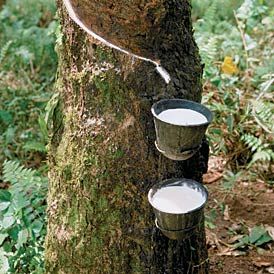
Our previous post revealed how Bamboo is being used by victims of floods to rebuild their lives. Now, rubber plantations are leading to increasing prosperity among people of Goalpara district in Assam. A lot of success stories have emerged, largely centered around those who have taken to growing rubber trees in their farms. Rubber grows easily in the North East regions owing to large tracts of unused land and inexpensive labour. Not only is the money good, it has had various positive impacts on the society and the way of living of the beneficiaries. 

Teresa Rehman writes in Tehelka about this Rubber Revolution:

The rubber board, a statutory body constituted under the Rubber Act, 1947, by the Ministry of Commerce and Industry has implemented several programmes for rubber plantation development in the Northeast. The first plantations, mostly confined to large estates, trial plantations were taken up by the forest and soil conservation department. However, since 1980s, small growers have been switching to rubber with some help from the Rubber Board. 

In fact, Goalpara district of Assam has been one of the Board’s success stories. Out of the total 4000 hectares of rubber plantation in Assam, around 2900 hectares are in Goalpara district itself. Over 7000 familes are dependent directly or indirectly on rubber plantations and their average income is more than Rs 10 crore per annum.

And the statistics of the kind of demand for rubber in our country:

More than 36000 articles ranging from giant truck tyres to tiny elastic bands are manufactured from rubber. In fact, an ambassador car has 300 rubber parts. The tyre-industry consumes nearly 85 percent of the natural rubber in India. 

What is even more interesting is the impact that this prosperity has led to in the traditional customs and ways of life in this region. To know more about that, read the complete article here.

The Weaving of Hope

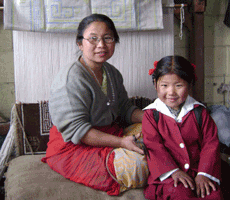
In the 1980s, women in Darjeeling went through a lot of turbulence especially due to the Gorkhaland agitation. Their primary means of earning a living was to work as maids and other petty jobs. But now, all that has changed significantly. The women have now adopted carpet weaving as a primary source of income, thanks to the assistance of Hayden Hall, an NGO based out of Darjeeling town. Tehelka’s Teresa Rehman writes in this article about how a turnaround was achieved in the lives of these women:

Tears roll down her cheeks as she recalls the turbulence during the Gorkhaland agitation of 1980s in Darjeeling in West Bengal. As Shannu Sherpa, 36, gives finishing touches to the new carpet she has woven, she narrates how her uncle and most of the male members fled to the jungles fearing atrocities by the security forces. “There were bandhs for as many as 40 days. The whole economy which had thrived on tourism collapsed and there was no income for many days. Moreover, houses were raided and there were atrocities on women by the security forces,” she says. 

It was during these trying moments that she found succour in carpet-making after she landed in Hayden Hall, an NGO in Darjeeling town. Then it was quite an uphill task for her to traverse the distance of nearly an hour from her village Singmari to reach the place. She says, “But it was worth it. I have brought up my children with these earnings after my husband’s death. I am not always able to fulfill their demands but I am happy that at least I can lead a respectable life here.”

Radha Karky, the administrator of Hayden Hall has been interviewed in the article. Some excerpts of her views:

“The idea behind introducing this alternate way of earning livelihood is because employment opportunities are very few here and there is tremendous pressure on these women. Here, they at least pick up a skill. It’s like being literate, gaining confidence. For illiterate women, coming up with beautiful hand-woven carpet is psychologically uplifting. These women would otherwise be going home to clean dishes. Even their meager wages are cut if they fall sick,” adds Karky. 

Interestingly, and perhaps more importantly, in addition to the wages that these women are able to earn, they also have the added security of medical care and life insurance!
About the economics involved, the article goes on to say:

Carpet making is not a viable option if done independently but Karky says, “Its viable in Hayden Hall. We ensure that a weaver makes at least Rs 1500 per month. While working at Hayden Hall, women are also enrolled in a health program that covers basic medical expenses, a lunch schemes, and their children benefit from the many children’s schemes, from day-care and health care to after-school tutoring to help with public or private school fees.” These women make carpets, which are then marketed by Hayden Hall in the two stores located in Darjeeling. These stores are also have an overseas shipping licence. Hayden Hall’s carpet weavers spend roughly a month on a three-by-six-foot carpet. 

Read the entire article here to get a sense of the freedom that these women have managed to earn for themselves. It is truly heartening to see an organization being able to achieve such a turn around for people, who only a decade ago, were grappling with uncertainty and turmoil.

Image courtesy: www.tehelka.com

Calendar

March 2010
M T W T F S S
« Feb    
1234567
891011121314
15161718192021
22232425262728
293031  

PROMOTION

"Neumonia and Other Sketch Stories" - A collection of sketch stories. Download the e-book for free. Click on the book cover below.
"The observations are acute: the sound of high heels on asphalt, the bit about how all BPO employees lose their hair very fast are spot-on. This book is a better, shorter alternative to any Sunday movie on TV. It's a little jewel" - Hindustan Times