Solar Power to Light Up Hawker Shops

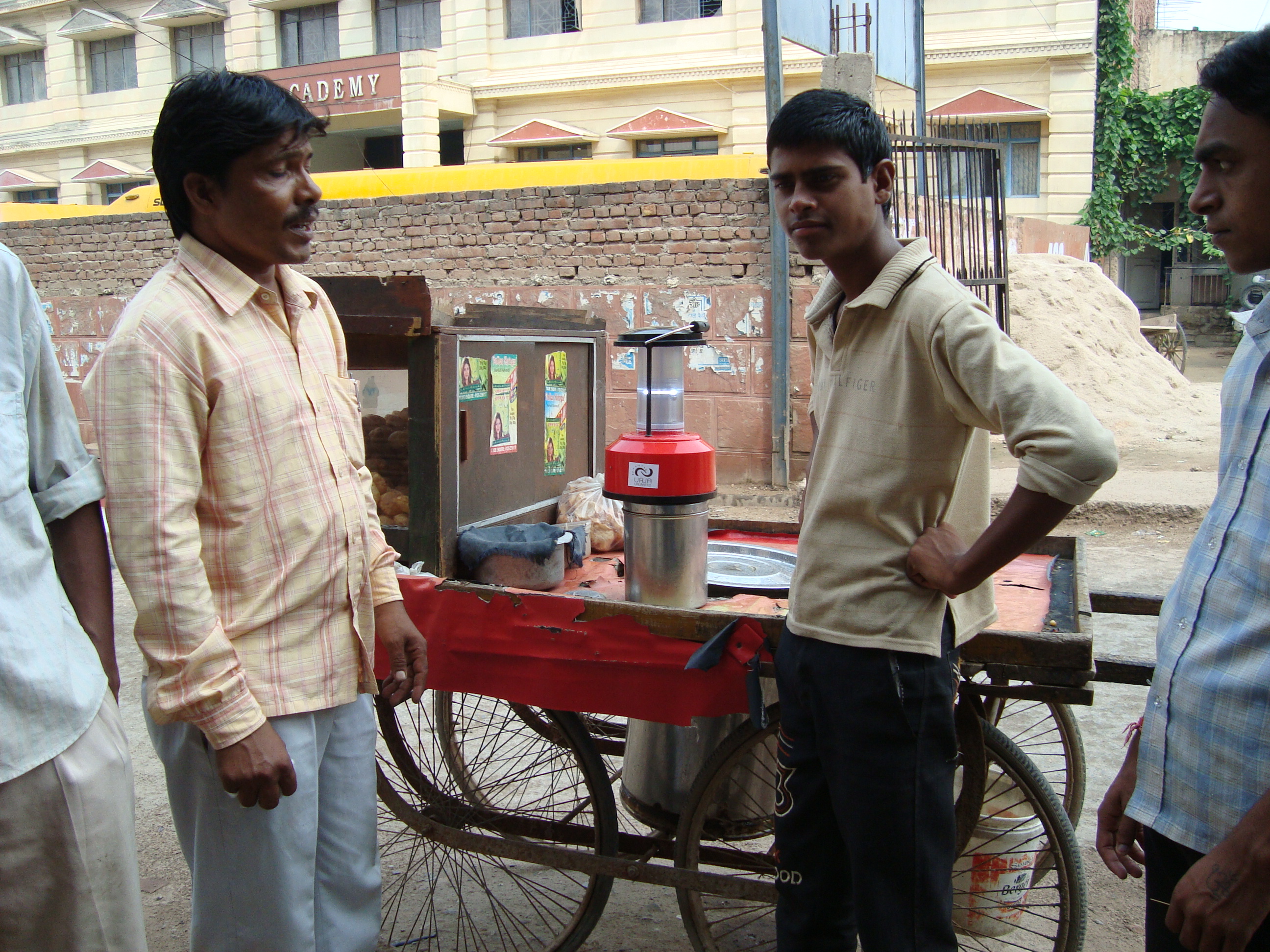
Those signature kerosene and petromax lamps at hawker shops have decorated our streets during its busy evenings for years now. They are a hawker’s constant companion and a basic necessity for their shops. But did you know that a hawker has to spend around 250-300 rupees every month for these lights? Parting with this big chunk of money from the handful that he earns becomes quite a burden. Accolades to Urja Unlimited, who understood this difficulty faced by the hawkers and came up with a fine solution – replacing the fuel lamps with solar power.

Urja Unlimited is an organization which was born with a novel idea of providing ‘energy for all’ through renewable energy. Urja aims to serve every village, town and city in India with efficient energy solutions. With its vision in mind, Urja initiated the project to support street hawkers and aspires to reach a million hawkers with their lanterns.

The main aim of the project is to completely eliminate the recurring fuel expenditure on the hawkers. Moreover, as we all know, there are environmental benefits attached to giving up the use exhaustible fuels. Also, the hawker gets to work in a fume free environment.

Over 150 hawkers in Faridabad enjoy the solar power

Solar power comes as a breather for hawkersThe first step towards energy efficiency was Urja Unlimited’s solar lantern project in Faridabad. Over 150 hawkers have opted for Urja’s lanterns which have given them a breather with their expenses. The brighter solar lamps have enlivened their surroundings, gotten rid of the risk of health hazards and brightened the faces of the hawkers.

Savitri Pandey, a hawker in Faridabad who has switched to Urja’s lantern, mentioned that she is now able to devote the cost savings on giving up the kerosene lamps to her children’s tuition needs. Saina Bano says that “Ab har mahina mittiktel (kerosene oil) chori se kharidane kay jhanjhat khatam.” Ashok, a hawker suffering from Tuberculosis, said that he is now spending less on his medical expenses.

Support to spread the cause

Replicating the success and spreading awareness across the country is a big task in the hands of Urja Unlimited now. The constraint is that the equipment is slightly priced on the higher side, around 2600 to 3600 rupees. Logically, the amount is equivalent to what the hawkers would spend over a year for their fuel costs and they need not spend any more on their fuels after this initial investment. Also, the lanterns can easily serve the users for almost 5 to 7 years. Urja intends to bring down the cost that could come on the hawkers by entering into partnerships with micro finance institutions, corporates and other philanthropic organizations.

How can you help this initiative?

With more people like you supporting the cause, we are sure that we can make some difference to the lives of more street hawkers. Here are a few things that you can do:

  • Introduce Urja Unlimited to your company and encourage a corporate social responsibility initiative
  • Contact Urja Unlimited to find out more about the initiative and help them serve better
  • Help spread awareness about the use of renewable energy

You can know more about the organization at www.urjaunlimited.in. Urja and The Better India shall assist you in sharing your contributions.

Make way for the Solecshaw!

Gone are the days when the poor rickshaw driver had to pull with all his might to tug his passengers up a slope. After the introduction of CNG buses and autorickshaws, Delhi now has another feather in its cap. On Gandhi Jayanti, it introduced a new initiative to convert all hand-drawn rickshaws to solar-powered.

Called the Soleckshaw, it is in test run in Delhi and will be mass produced in a month if all goes well. Besides easing the load of the rickshaw puller and improving his health, it will also enable him to earn more. Shashank Kaushal reports in NDTV:

Solecshaw will run as a test project between the Old Delhi railway station and the Red Fort. Both places will have rickshaw counters selling Rs 15 fare tickets for two people. The batteries run for 12 hours. Spare ones can be charged at the Chandni Chowk metro station.

“I think it is advantageous for the poor rickshaw pullers. They can earn much more. They will save more for their family and they would last more than three years,” said Kapil Sibal, Union Minister, Science and Technology.

With maximum speeds of 15 kilometers per hour, the Solecshaw is expected help a rickshaw puller earn more than his present average daily earnings of 150 rupees.

Yes, it is just a drop in the ocean. But we need all of these drops to make a big difference, and we welcome this small initiative by the Delhi government to bring broad smiles to this largely ignored section of workers.

Read complete article here.

Image Courtesy: NDTV.com

Link Provided By: Faiq Gazdhar. Thanks!

Calendar

September 2010
M T W T F S S
« Aug    
 12345
6789101112
13141516171819
20212223242526
27282930  

Recent Comments

PROMOTION

"Neumonia and Other Sketch Stories" - A collection of sketch stories. Download the e-book for free. Click on the book cover below.
"The observations are acute: the sound of high heels on asphalt, the bit about how all BPO employees lose their hair very fast are spot-on. This book is a better, shorter alternative to any Sunday movie on TV. It's a little jewel" - Hindustan Times