Radio Bundelkhand – Giving Voice to the Voiceless

Azadpura is a village in Bundelkhand region. This area faces acute water scarcity and one problem that the women faced was a faulty well which required urgent repairing. The women aired this problem on Radio Bundelkhand and within four days the concerned authority replaced the missing wheel of the well. This is the power of Radio Bundelkhand, an initiative of Development Alternatives.

Community Radio for facilitating dialogue and interactive communication

The purpose of setting up Radio Bundelkhand, as identified with the help of our communities in the radius of the radio station, is to work along with them to use this communication medium to create awareness, give information, participate in local self governance and provide entertainment – all based on requests and feedback from the community. The audience includes the communities in the radius of the broadcast range – with special attention to women, youth and the marginalised groups.

 
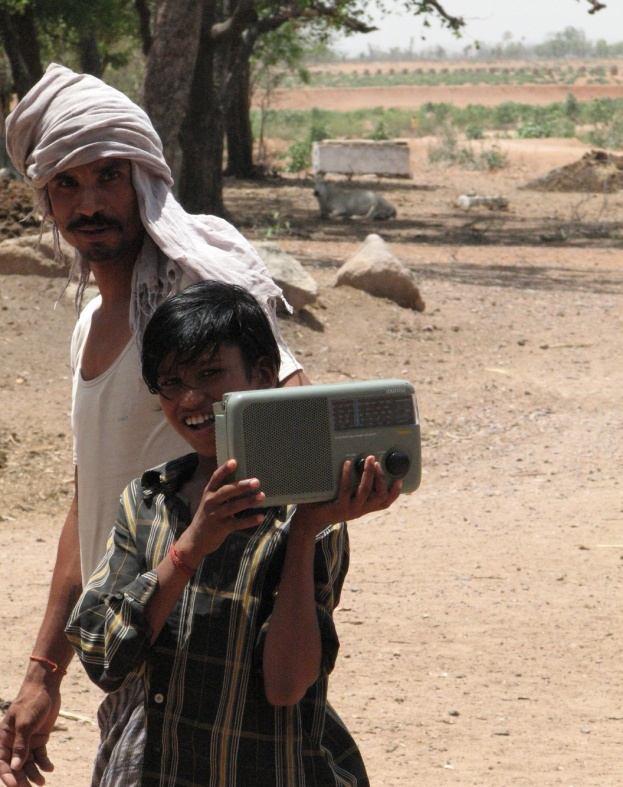
Listening to Radio Bundelkhand

Listening to Radio Bundelkhand

Community Members on the Radio

Community Members on the Radio


The community and DA, jointly manage the station. There are five community reporters and six community coordinators. The villages these reporters represent are Azadpura, Ramnagar, Sitapur, Basova, Bagan, Bhagwantpur, Ghatao, Jamuniya, Gujerra Kalan, Mathrapur and Ghatao. There is also a Management Committee comprising the Sarpanch (elected village-head) of Basova Village, doctors, farmers and Self Help Group members.

Until now, Radio Bundelkhand has the longest duration of programming of four hours a day, seven days a week, in Bundelkhandi and Hindi amongst the government licensed community radio stations in India. The Government of India has given licenses to several NGOs throughout India to start community radios in their project areas. DA is one of the first to set up such a radio with the communities it has been serving for more than two decades in the Bundelkhand region.

The communities have decided that they would like information related to employment and livelihood opportunities, development of women, girl’s education, legal rights, farmers’ issues, training, their culture and history, how to ensure the availability of basic infrastructure such as water, energy and roads, development issues, and any other information sought by the communities. The broadcast timings in the morning and evening have been selected by the communities, with the women preferring the morning and the men the evening.

Programming Content on Radio Bundelkhand
Vandana –Devotional songs broadcast every morning.
Khet Khaliyan – It includes the Jhansi Mandi (unorganized market) prices for farmers so that community gets all the information related to agricultural products. Bundelkhand Radio also
broadcasts discussions about agriculture issues like how to protect seeds, crops & vegetables
from insects. Experts answer question asked by the farmers.
Bal Bandhu – Especially for school-going children. Moral stories, poems and jokes by school
children are included. Story telling through the Radio Jockeys is also a part of this programme.
Bundelo harbolo ke- This is about the Freedom Fighters of Bundelkhand. Stories of the freedom fighters & songs related to freedom fighters are also broadcast.
Aas Paas – In this programme Bundelkhand Radio broadcasts information on Right to
Information (RTI) and any other problem.
Mere Bundeli Mere Geet – is a listener’s programme in which they get the opportunity to listen to their choice of songs.
Amma ke Chauki Se – In this programme community women give their ideas on home receipes and step by step instructions for preparing the dish.
Nuskhe Nani Dadi Ke – In this programme older woman give tips on using home remedies or
Desi nuskhe for common ailments and diseases. Also, give tips of using simple home remedies and alternative herbal medicine, available from the average kitchen shelf.
Radio Drama – On every Sunday Bundelkhand Radio broadcasts a radio drama. In this
programme reporters discuss an issue and convey the messages related to social issues like
dowry, female foeticide, importance of education etc.
Sathin – Sathin is a special programme for women. Women from the community tell their story. They discuss the struggle in their lives and success story too. These women also share their
feelings what they want or wish for themselves.
Chhotou Kam Badou Munafou – This programme is for those people who want to do small business. Small entrepreneurs give tips to take up small business.

The programming, based on issues and content identified by the communities, is broadcast in the formats which they have preferred, that include the use of traditional Bundelkhandi songs, folk music and nataks, discussions, reports, commodity prices, phone-ins, experts speak, coverage of events in villages, jokes and satire, listeners’ letters and feedback. The Wireless Operating License was issued on July 31st, 2008 and the first transmission took place on August 15 2008 with the broadcast of the national anthem. Meanwhile the selected community reporters were trained over three months and a woman from Sitapur village inaugurated the station on the eve of Diwali. Community radio broadcasting/narrowcasting has allowed the rural poor to develop their communication in a language they understand. Community radio fosters debate on issues, facilitates access to government, decision-making and helps community members to organise themselves and evolve to manage their own affairs. Radio Budelkhand is characterised by its signature tune and jingles which declare that it is “Apna Radio Apni Baatein” – Our radio Our conversations.

Reaching our communities

The reach of the community radio is in a wide range of approximately 5-10 kms and 25 villages with a population of 15000 in the coverage area that are benefiting through the infotainment-based programmes. So far, Radio Bundelkhand radio has penetrated to the rural communities settled in and around TARAgram Orchha like the villages of Gundrai, Chandravan, Bagan, Orchcha, Sitapur, Azadpura, Lachmanpura.

The targeted beneficiaries are the marginalised and poorest with special emphasis on women and the unemployed youth who are the most vulnerable but also the potential change-makers. By selecting women community reporters, marginalised community reporters in an average age group of 20 we hope to reach them better.
The Management Committee also has a woman self-help group head. DA aims to ensure the participation of local people for the programming, broadcast and management of the station by the community itself.

The above article was written by Indira Mansingh, Chief Advisor, Development Alternatives.

Thank you Purnima Gupta for sending this across!
Previous article of Development Alternatives – Click here.

On The Eve Of Development

scatec-solarNeetu (13) is a student of class seven. Her village, Rampur located in Jhansi district of Uttar Pradesh, has a primary school (up to standard five), so she has to go to the adjoining village Mathanpura for her schooling. She has two sisters and one brother. All of them go to school.

Her cousin Rinkoo studies in class eight. But she does not go to the school and would appear for the exams only (because of the social constraints). Almost all boys in the village go to school but girls study up to class 7 or 8 only, because after 5th they have to go to the school in adjoining village.

Neetu’s mother, Girija devi works at home and helps her husband in the field. Both the Neetu’s parents can not help her in her studies. Neither do they have any tuition facility. Neetu has to do her home work by her own and she does it under the kerosene lamp, as the village has no electricity.

Most of the energy demands in Rampur depend on the fossil fuels. Here kerosene lamps are used for the lighting purpose, diesel pumps are used for irrigation, cow dung for cooking and so on. There is no TV, fan etc in the village (although they can afford it). Children study under the kerosene lamps in unhealthy conditions. Women try to finish their cooking etc before it gets dark in the evening.

Although the village is economically sound – Rampur has a good groundwater table and acres of cultivable land are being transformed into a model farm with multiple cropping (three crops in a year) – it is still backward with harsh living conditions and no electricity.

There is a lack of knowledge about the importance of education, water management, health and hygiene etc.

But then there came a ray of hope.

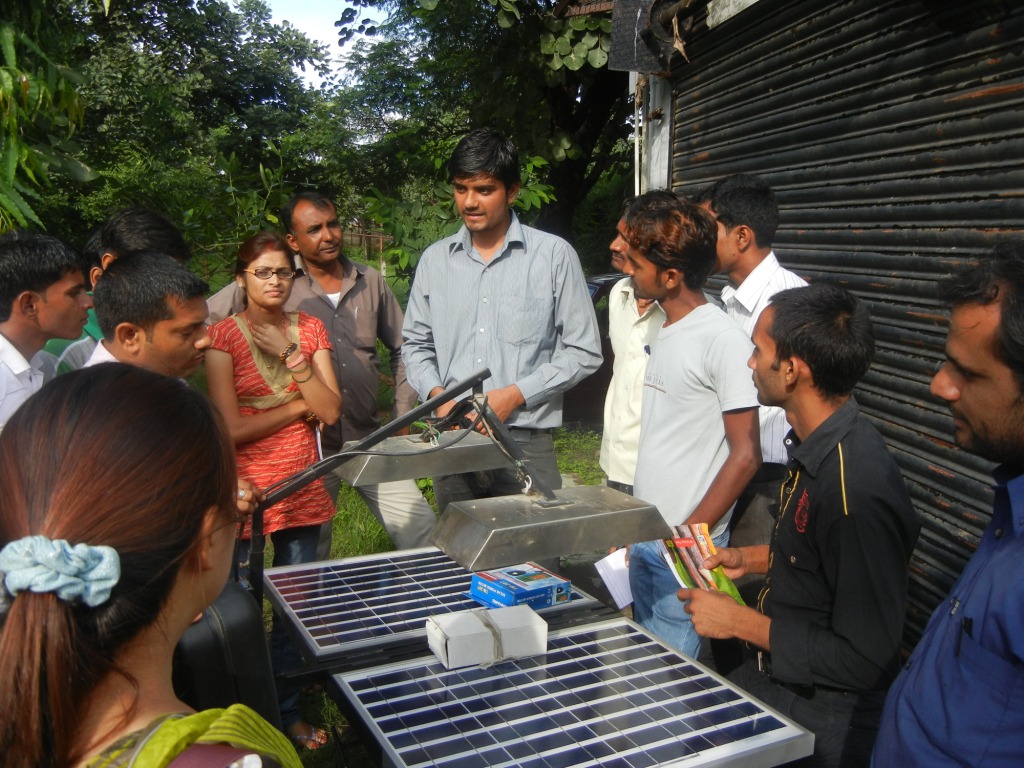
The village was electrified under the village energy security plan of Development Alternatives in collaboration with the Scatec Solar, a Norway based company to promote Solar Energy. The goal of the project was to provide electricity by tapping renewable energy (solar energy), as well as provide educational and training support to the villagers in the areas of Education, healthcare, raising agricultural productivity, and improving water management.

A Village Energy Committee has been formed with local people’s representatives plus experts actively involved in the development of the area. This committee plans, implements, monitors and controls the project activities. The committee is helping to construct, operate and maintain the center as well as to mobilize the rural masses for various community activities.

Sports equipments have been provided in school for the children by Development Alternatives.
The work on the power plant has been completed on a fast track and it was inaugurated on 26th Jan 2009.

So after this republic day Neetu and all her friends haven’t been studying under the kerosene lamp. They now study under CFL. Girija devi watches TV and has installed a fan to get relief from heat and mosquitoes.

But, still, there is a lot to be done.

There is a need of a program for the children specially girls to improve pre-school, middle school and high school education plus need for vocational training in skills development.

A need to teach villagers water management practices such as the use of holding ponds, provision of potable water, sustainable agricultural practices, and health services.

Rural transformation in India rests in the hands of women. You may have heard that if you give money to the woman of the house, she takes care of the family. If you give the same money to the man of the house (in rural India), the woman and children will see little of it.

The idea is to encourage and promote women empowerment by providing them basic necessities, resources and income generating skills that will go on to improve the quality of their life.

Article submitted by: Suman Raina. Thanks for your contribution!

Picture Courtesy: Scatec Solar

The Man With The 100 Million Jobs Idea

Perhaps not many Indians know him, but he is widely credited to have been the inspiration for Nobel laureate Al Gore’s interest in climate change. Now, renowned environmental scientist Dr. Ashok Khosla has plans for creating 100 million jobs by 2018 in rural India. As founder and chairman of Development Alternatives, a New Delhi-based non-profit involved in the creation of micro-factories that would make basic facilities available to the village-dwellers, and enable them to generate employment. The initiative has already created 3 million jobs over the past 15 years.

Sunita Sohrabji writes in indiawest.com about the ideas and ideals of the man who is the brain behind the successful $120 million venture:

“Poor people are seeing more products, but have little access to them. The poor do not have purchasing power,” said Khosla, the 2002 winner of the United Nations’ Sasakawa Environmental Prize, and the Schwab Foundation’s outstanding social entrepreneur award in 2004. Khosla, an alumnus of Cambridge and Harvard, was recently made an Officer of the British Empire.

Development Alternatives uses a market based approach to further its cause, rather than relying on charity. Wondering how it works?

In a typical model, the village will form a cooperative to purchase the equipment needed for the project, and determine wages for the workers, typically slightly above the area’s minimum wage. Development Alternatives’ social enterprise arm, Technology and Action for Rural Advancement, markets the products created by the villagers.

The organization’s compressed earth block technology is being used throughout the country to ease the shortage in housing for rural dwellers. More than half a million homes have been built using the technology, in which villagers mix raw earth with a stabilizer to create a brick, with a mechanized or manual soil press.

The organization believes in innovating to create new opportunities for the poor, and lays particular emphasis on social as well as environmental sustainability.

TARA and Development Alternatives have also created a new-generation weaving machine that allows its user to be more productive and create higher-quality handlooms.

The organization has also created a paper-making machine, which recycles wastepaper and cotton rags into high-end paper goods, or standard paper for use in classrooms.

This is not all. Besides helping the villagers in improving their agricultural output, Development Alternatives has now started a new project – franchised village cyber kiosk. Called Tara-kendras, these centres can impart vocational training, career counseling, agricultural and medical advice, a market place for buying and selling as well as accessing government services.

“This is one of the most revolutionary things we’ve developed,” said Khosla. “It brings the village into the global economy and the global economy into the village.”

“It’s extreme value at very low cost and one of the major solutions to solving the problem of poverty in India,” he asserted. Three hundred Tara-kendras are currently in operation throughout the country, and the enterprise will become profitable when 1,000 kiosks are established.

The efforts of Development Alternatives and Dr. Khosla are laudable. He has several awards and achievements to his name, not the least of which is that as a Harvard teaching fellow, he was responsible for designing and teaching the very first class on the environment! Yes, the same that Gore took during his first year there!! In spite of all his success, Dr. Khosla’s heart lies with India’s rural poor, and his endeavors speak highly of his commitment.

Development Alternatives and TARA have taken some innovative steps in promoting rural employment. Read more on these in the article here.

Image courtesy: indiawest.com

Act Now For The Better India.

Calendar

September 2010
M T W T F S S
« Aug    
 12345
6789101112
13141516171819
20212223242526
27282930  

Recent Comments

PROMOTION

"Neumonia and Other Sketch Stories" - A collection of sketch stories. Download the e-book for free. Click on the book cover below.
"The observations are acute: the sound of high heels on asphalt, the bit about how all BPO employees lose their hair very fast are spot-on. This book is a better, shorter alternative to any Sunday movie on TV. It's a little jewel" - Hindustan Times