English Radio Lessons – What an Idea!

Indian television afficionados may have come across an advertisement of a mobile service provider depicting how a mobile phone could be used to spread education in remote areas. It got us interested and we wanted to see whether such an idea (no reference to the company!) was actually being implemented. After some not-so-intensive news searching, we came across an article by BBC India’s Amarnath Tewary which describes how the radio is being used in Bihar to teach English to school children.

The Bihar Education Project, in collaboration with the Education Development Center (a US-based organization), launched this innovative teaching idea in order to improve literacy of the state. Bihar currently has a literacy percentage of only 47%.

Amarnath Tewary reports:

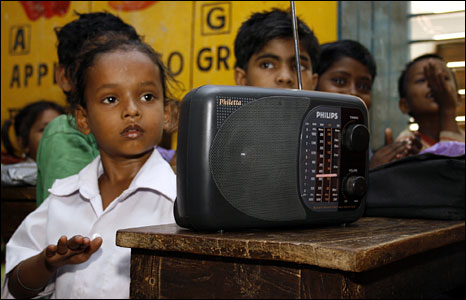
The students are looking inquisitively at a radio set perched on a plastic chair in the middle of the classroom in the capital, Patna.
They are all waiting for a new English lesson to begin – on the radio. 

So, for half an hour, four days a week, millions of primary students in Bihar today learn English through this radio lesson.

The year-long interactive radio lessons are being broadcast by the four regional state-run All India Radio stations. The lessons cover seven million students attending 65,000 primary schools in all the 38 districts of the state.

And what does a student have to say about this?:

“It is very easy to learn English on radio. Every day we wait for this class. Even if the teacher is not in the class we learn and enjoy the programme,” a student, Sakshi Kumari, said. 

The state government has granted a 1000 rupees to every school to enable them to buy a radio. And the benefits of such initiatives in Bihar are told in this para:

Interestingly, backward and dirt-poor Bihar appears to be a trend setter here – a recent federal government report found that school students in the state are now faring better in English and mathematics than anywhere else in the country. 

The article is very well written and also gives you the perspective of the teachers in these schools. It is truly inspiring to see such initiatives being taken in the field of education, which is perhaps one of the most important areas requiring development in our country.
Last, but not the least, we couldn’t help but add the punch line – What an Idea!

Image courtesy: Prashant Ravi from BBC News

Innovations At Times Of Crisis

The Kosi river disaster in Bihar earlier this year caused widespread devastation. However, if we try to look for a silver lining or at least something to appreciate, we can talk about the ‘babus’ who tried to bring in new technologies and innovations to help the victims pick up the pieces of their lives, and start again. Be it toilets made of bamboo or software for tracking missing persons, government officials are playing an important role in rebuilding the community.

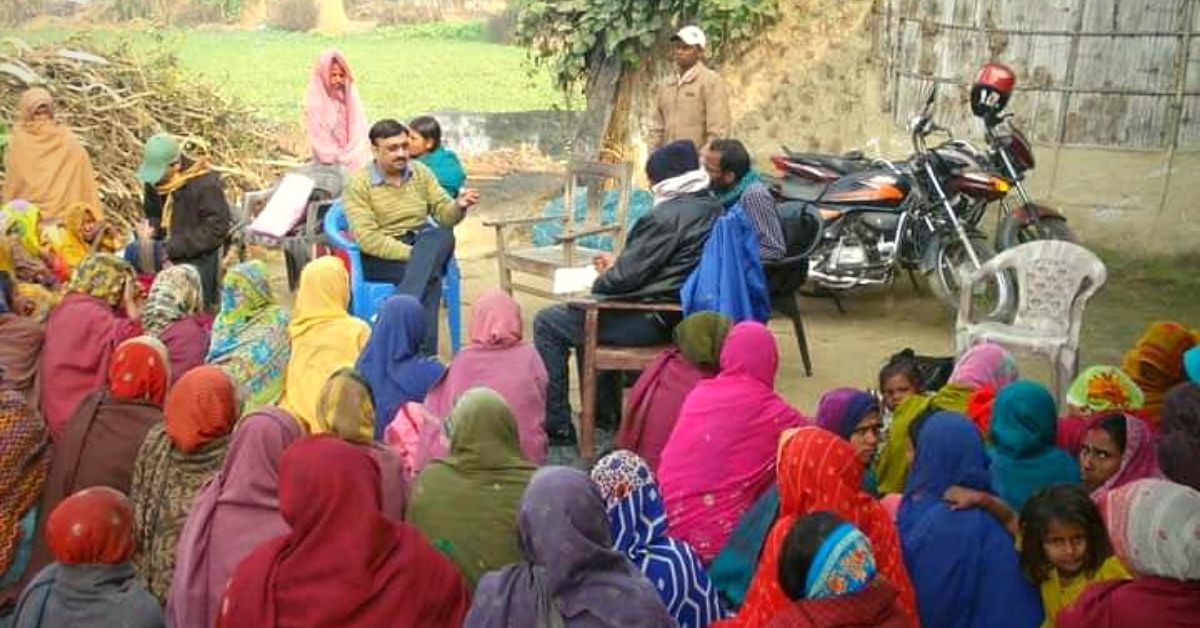
Bamboo is available in plenty, and the people are being encouraged to use it to build their homes as well as furniture for use and sale. The “bamboo economy” plan is being drawn by the Bihar Government to ensure that the workers are guaranteed an income and training programs to help generate employment. Women’s self help groups are also being set up to promote the bamboo revolution. Alok Kumar Gupta writes in Down to Earth:

Officers claim that a bamboo revolution is on the cards. Now that floodwaters are receding, H C Sirohi, commissioner of Saharsa division and in charge of flood relief operations, has launched a training programme to make bamboo furniture. “At first all we saw were resigned faces of thousands of flood victims grieving the death of their dear ones. We then decided to use local resources to help them rebuild their lives. Bamboo seemed the obvious answer as it grows here in plenty and we believe it will usher in employment opportunities,” Sirohi said.

The Bihar government has finalized a blueprint to create a bamboo economy in the flood-hit northern and central Bihar. Talks with the National Bamboo Mission have begun for setting up women’s self-help groups. National Bamboo Mission is a government body created by the Union Ministry of Agriculture to promote the bamboo sector. The government has assured flood victims that it would purchase their bamboo furniture for schools and government offices, replacing wooden benches. It also plans to sell the furniture in other states.

Besides relief work, the Government’s other priority has been tracking missing persons. In the aftermath of the calamity, thousands of people have been displaced from their homes, and it is an enormous task to locate these people. The government had to develop new software with the help of IT companies, since the IBM software previously used in Sri Lanka after the 2004 tsunami worked on details like passport number and driving license, which most people in the flood-hit districts did not possess.

This spurred Jeevika to develop a software with the help of IT majors. This one is based on data such as the name of the missing person, his village, block and district. Called the Missing Person Tracking System (MPTS), this software is being used to track down lost relatives.

“Data collected by Jeevika and the officials from flood-hit districts is entered into the software. We have ensured that names of the district, block and village are automatically corrected even if wrong spellings are keyed. Over a dozen families have been re-united with their missing members,” added Choudhary.

The state has also been doing a commendable job of monitoring relief camps and plugging in any gaps. “Mobile inspectors” with GPRS-enabled phones have been deployed by the State Disaster Management Cell to travel incognito to these camps and take photographs of their conditions.

The most innovative invention, however, came from the flood victims themselves. Stranded people created makeshift boats from six pieces of thick banana stems tied together using a local patua fibre. Such boats could stay afloat for a while since the banana stems absorb water and expand, thus tightening the joints held by the ropes. This is so original and useful that the army and navy men present in the rescue operations have recommended its study for possible uses. We would like to salute the Indian spirit, which can come up with amazing inventions even in the middle of a storm.

Read the complete article here.
Image Courtesy: Down to Earth

Calendar

September 2010
M T W T F S S
« Aug    
 12345
6789101112
13141516171819
20212223242526
27282930  

Recent Comments

PROMOTION

"Neumonia and Other Sketch Stories" - A collection of sketch stories. Download the e-book for free. Click on the book cover below.
"The observations are acute: the sound of high heels on asphalt, the bit about how all BPO employees lose their hair very fast are spot-on. This book is a better, shorter alternative to any Sunday movie on TV. It's a little jewel" - Hindustan Times