








A Barefoot Journey to Tilonia
A less traveled track to Tilonia gives one a journey into Indian entrepreneurship and perhaps changes the way our villages are perceived by city dwellers. Tilonia brings you face to
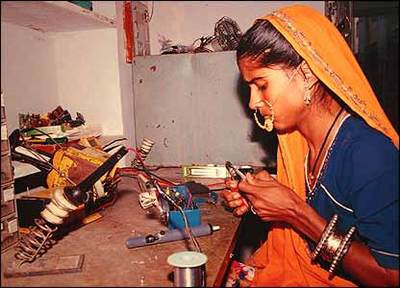
A less traveled track to Tilonia gives one a journey into Indian entrepreneurship and perhaps changes the way our villages are perceived by city dwellers. Tilonia brings you face to face with the real spirit of India. Its misty hopefulness uncovers the nature of the task that is ahead for a social entrepreneur, its uniqueness and challenges.
Tilonia is a small town 25 kms from Kishangarh near Ajmer in Rajasthan. Barefoot College, established in 1972, inspires this town with the conviction that solutions to rural problems lie within the community. These solutions are broadly classified by Barefoot College into solar energy, healthcare, education, water, rural handicrafts, people’s action, communication, women empowerment, income generation, wasteland development, electricity and power as well as social awareness and conservation of ecological systems in rural communities.

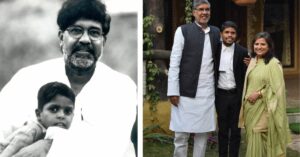
Barefoot College was founded by Sanjit ‘Bunker’ Roy, an Indian social activist and educator. Roy was influenced by the philosophy of Mao Zedong, and modeled his organization after Mao’s Barefoot Doctors. Roy has worked all his life with the Barefoot College.
Spread over more than 8 acres of land, the campus of Barefoot College was built between 1980 and 1986, designed by a team of rural ‘barefoot’ architects, masons, blacksmiths, farmers and members of women groups who sat and struggled through the initial basic designing of the campus. This institution believes in imparting informal, non-structured, on-the-job practical training by identifying the poor, unemployed youth who have been unable to finish their formal education and have returned to their respective villages as dropouts. The five principles which are an integral part of the functioning of the college are equality, collectiveness, self-reliance, decentralization and austerity.
Bunker Roy, founder-director of the much talked-about Barefoot College at Tilonia in Rajasthan’s Ajmer district, has been chosen for 2009’s Robert Hill Award for his contribution to promotion of photo-voltaics (solar energy). He is the first Indian to be recognised by the Global Solar Community which had its 24th European Photovoltaic Solar Energy Conference in Hamburg, Germany, this weekend.
Click here to read more about this in The Hindu.
The education program focuses on the overall development of rural children, with literacy being just one part of it. It encourages hands-on or learning-by-doing process of gaining knowledge and skills. Lessons are focused on awareness about the environment and socio-economic and political forces that dominate development. The aim is to provide the children with a right balance of education and literacy so that they choose to stay in their village and work for its development. The college has different programs for children and women. There are Balwadis (rural crèches) established for children between the age of 6 months-5 years for the convenience of working mothers. Night schools have been set up for ‘working children’. There are bridge courses, courses for night school children who aspire to join formal day schools. In these night schools, initiatives like the children’s parliament are established which allow them to participate in the management of their schools through a democratic process. Candidates are selected through a proper election process, giving them an idea of the working of a democracy.
There is also a huge emphasis on the holistic development of women by empowering them socially, financially and politically. In the past 38 years, the college has trained more than 15,000 women in jobs ranging from construction work, education, metal craftsmanship, toy making and solar engineering, to mechanical repair and fabrication, health care, water testing, handicrafts, film making and social activism.
The Barefoot College has setup eight field centers in Rajasthan and a society known as SAMPDA (Society for Activating, Motivating and Promoting Developmental Alternatives) through the collective efforts of which the Barefoot approach is replicated in rural communities across 14 states in India.
The global response received by the organization is worth acknowledging. The institute has witnessed semi-literate middle aged woman traveling from places as diverse as Afghanistan, Cameroon, Gambia, Mali and Sierra Leone to undergo training to become barefoot solar engineers.
To know more about this organization and to read on some of its wonderful initiatives, please visit their website at www.barefootcollege.org.
This story made me
 97
97 121
121 89
89 167
167
Tell Us More
We bring stories straight from the heart of India, to inspire millions and create a wave of impact. Our positive movement is growing bigger everyday, and we would love for you to join it.
Please contribute whatever you can, every little penny helps our team in bringing you more stories that support dreams and spread hope.













 Home
Home
 Read
Read
 Watch
Watch
 Contribute